

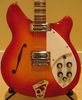
Fireglo and mapleglo 330s necks have a dark "redified" maple strip in their center and two similarly colored wings on their headstocks.
Are there any 330s that have solid light maple necks? The jetglo's perhaps or other solid opaque colors?
When did Rickenbacker move from using walnut for the dark strips to using the redified maple?
330 Necks Without Redified Maple Strips?
Moderators: rickenbrother, ajish4

Re: 330 Necks Without Redified Maple Strips?
That's "retified", a process of retification.LenMinNJ wrote:Fireglo and mapleglo 330s necks have a dark "redified" maple strip in their center and two similarly colored wings on their headstocks.
Are there any 330s that have solid light maple necks? The jetglo's perhaps or other solid opaque colors?
When did Rickenbacker move from using walnut for the dark strips to using the redified maple?
The stability is unbeatable and since it's Maple, it finishes just likae the surrounding un-retified strips and doesn't need filling as the more open grain of the Walnut does.
Unfortunately, that stability comes from hardness and as a result, tool wear became a huge issue. Just trying to drill a simple hole, for example, proved to be a challenge, with full carbide tools becoming dull almost immediately, making the wood surface burn.
Re: 330 Necks Without Redified Maple Strips?
Is this the same process Gibson is using for their colored Maple fretboards?
Great Ramp In My Opinion.
Re: 330 Necks Without Redified Maple Strips?
Thanks, John. I guess you decided that the benefits outweigh the negative of tool wear.johnhall wrote:That's "retified", a process of retification.
Do all 330s have the necks with the retified strips?
When did you switch over from using walnut? It seems as if retification is a recently developed process, perhaps only since 1997.
-
analogpackrat
- Member
- Posts: 496
- Joined: Tue Jul 24, 2007 5:34 am
Re: 330 Necks Without Redified Maple Strips?
Here's a nice paper on retification for those science/engineering nerds among us.
http://www.thermotreatedwood.com/Resear ... cation.pdf
I'm curious if RIC experimented with other domestically produced (though not necessarily native) wood species when looking for a suitable replacement for bubinga and/or shedua? The eastern US has some nice, durable, hardwoods that most people don't even know about like Black Locust, Honey Locust, and American Persimmon. These are hard and dense woods. Persimmon is in the same genus as ebony.
Out here in the west we have native madrone which is quite hard and has a beautiful closed-grain pink wood that ages to a nice orangey-red. It's harder than cherry, but I gather it is not easy to dry and is prone to have reaction wood. Then there's all of the eucalyptus here in California. It seems like most mills just don't even bother with it because it also checks badly if not dried properly. But there are a few small operators who are learning how to do it (the Aussies have it figured out for many species of euc, so it's not rocket surgery).
I wonder how these woods respond to retification? Anyway, I'm glad that RIC is trying to be responsible about the wood it uses.
http://www.thermotreatedwood.com/Resear ... cation.pdf
I'm curious if RIC experimented with other domestically produced (though not necessarily native) wood species when looking for a suitable replacement for bubinga and/or shedua? The eastern US has some nice, durable, hardwoods that most people don't even know about like Black Locust, Honey Locust, and American Persimmon. These are hard and dense woods. Persimmon is in the same genus as ebony.
Out here in the west we have native madrone which is quite hard and has a beautiful closed-grain pink wood that ages to a nice orangey-red. It's harder than cherry, but I gather it is not easy to dry and is prone to have reaction wood. Then there's all of the eucalyptus here in California. It seems like most mills just don't even bother with it because it also checks badly if not dried properly. But there are a few small operators who are learning how to do it (the Aussies have it figured out for many species of euc, so it's not rocket surgery).
I wonder how these woods respond to retification? Anyway, I'm glad that RIC is trying to be responsible about the wood it uses.
If it is to be, it is up to me.
Re: 330 Necks Without Redified Maple Strips?
I'm still looking for an answer to this question.
Were any 330's (or 335s, 340s, 345) made with solid light maple wood necks, with no retified strips?
What if I broaden the search to include any normal-scale, 24-fret, dot-marker necks?
Is the 350MG (but not the v63 or v59 or c58 or JL) the only Rick model that meets these specs?
Were any 330's (or 335s, 340s, 345) made with solid light maple wood necks, with no retified strips?
What if I broaden the search to include any normal-scale, 24-fret, dot-marker necks?
Is the 350MG (but not the v63 or v59 or c58 or JL) the only Rick model that meets these specs?
Re: 330 Necks Without Redified Maple Strips?
Not sure, but I think the Susanna Hoffs model was as well, granted it was in jetglo.LenMinNJ wrote:Is the 350MG (but not the v63 or v59 or c58 or JL) the only Rick model that meets these specs?

Re: 330 Necks Without Redified Maple Strips?
Though it's not a "modern" Rickenbacker as this forum indicates.....yet it's a branch off the 330 tree, I'll include it....the 331 Lightshow model has no strips:

This example is stripped of finish (that's old tape residue shown near the nut & heel).
This example is stripped of finish (that's old tape residue shown near the nut & heel).
-
sloop_john_b

- Rick-a-holic
- Posts: 13843
- Joined: Tue Jan 25, 2005 6:00 am
Re: 330 Necks Without Redified Maple Strips?
Thanks!
Just another cool detail of the 331s, in addition to the longer neck heel, bound fretboard etc.
Their basic neck construction is a predecessor to the modern 24 fret 330, so I think it's relevant to the discussion here.
Just another cool detail of the 331s, in addition to the longer neck heel, bound fretboard etc.
Their basic neck construction is a predecessor to the modern 24 fret 330, so I think it's relevant to the discussion here.