
Does Rickenbacker supply wrenches to adjust your neck?
Moderators: rickenbrother, ajish4

Re: Does Rickenbacker supply wrenches to adjust your neck?
According to Mr. Hall....they size down the Xcelite type driver they offer so it is probably not an issue for them.
Re: Does Rickenbacker supply wrenches to adjust your neck?
I bought my driver from Pick of the Ricks a few years ago so I assumed it was the same tool. It fits fine in my 650 and my 2010 4003, so maybe the 4004 is just an oddity.
-
chefothefuture

- Advanced Member
- Posts: 1886
- Joined: Sun Oct 30, 2005 6:00 am
Re: Does Rickenbacker supply wrenches to adjust your neck?
johnhall wrote:In other words and to sum it up succinctly, this whole thread was about a four dollar problem.

Well, your input is always helpful and sometimes humorous.
Helps to avoid as one Rickenbacker "historian" put it, misinformed manipulations.....
Re: Does Rickenbacker supply wrenches to adjust your neck?
To be honest, and maybe I am too sensative..... but I was honestly offended by it. I came here a few weeks back with some serious Ric enthusiasm. I have been a fan for decades and have been passing on the infatuation to my son. I have been involved in the retail side of the music business for over thirty years and am fairly familiar with the customer service concept. I have also sold a new Ric or two in the shops I have worked in and my enthusiasm for the brand would have been hard to beat.
I started this thread when I was somewhat frustrated as a player because I was having the most difficult time I have had in 27 years of playing in finding a tool that was needed to make my bass playable. I purchased the bass to play and was unable to take it on a few gigs because I could not easily adjust the neck. I did not mean for it to insult the company or that mgt of the comapny. I was just trying to voice my opinion and might have come accross the wrong way. I was honestly shocked when I realized that Rickenbacker did not supply the tool with the instrument and a little irritated that after purchasing the one on line that did not fit. Just my .02 for what it is worth.
I started this thread when I was somewhat frustrated as a player because I was having the most difficult time I have had in 27 years of playing in finding a tool that was needed to make my bass playable. I purchased the bass to play and was unable to take it on a few gigs because I could not easily adjust the neck. I did not mean for it to insult the company or that mgt of the comapny. I was just trying to voice my opinion and might have come accross the wrong way. I was honestly shocked when I realized that Rickenbacker did not supply the tool with the instrument and a little irritated that after purchasing the one on line that did not fit. Just my .02 for what it is worth.
Last edited by armybass on Fri May 04, 2012 4:23 pm, edited 1 time in total.

Re: Does Rickenbacker supply wrenches to adjust your neck?
Don't take it to heart chap, I think the fact that we have taken 4 pages to discuss is positive and not negative, whether it be trivia or not.
Re: Does Rickenbacker supply wrenches to adjust your neck?
Thank you Sean, I appreciate that. I must say that I have truly found this to be the friendliest and most helpful of any internet bass forum I have ever been on.
Re: Does Rickenbacker supply wrenches to adjust your neck?
And to be very fair..... I called Mr. Hall and voiced my perspective. Not only did he take my call, but he listened to me and and said he meant no offense.... that just doesnt happen. I appreciate your time and your explaining to me your position. You did not have to do that.
-
HydrasBreath
- Junior Member
- Posts: 135
- Joined: Wed Jan 04, 2012 11:42 am
Re: Does Rickenbacker supply wrenches to adjust your neck?
Yeah I also bought the xcelite driver and it doesn't fit on my new 4003. Another driver I tried also doesn't work.
1978 "Unionjackglo" 4001
2010 Jetglo 4003
2011 Fireglo 4003
Ampeg SVT-VR
Ampeg 810AV
Orange AD200B Mk III
Orange OBC115
2010 Jetglo 4003
2011 Fireglo 4003
Ampeg SVT-VR
Ampeg 810AV
Orange AD200B Mk III
Orange OBC115
-
jingle_jangle

- RRF Moderator
- Posts: 22679
- Joined: Wed Dec 22, 2004 6:00 am
- Contact:
Re: Does Rickenbacker supply wrenches to adjust your neck?
Although most Rick truss rods fit properly into their cavities when new (and by "properly" I mean that the X-Cellite tool will go over the nut with no struggle..), because the necks are wood, which is organic and varies in hardness both while new and as it changes to match its environment, the occasional new guitar or bass, and many older instruments (especially 12s and basses...) will see the nuts too close to the floor of the truss rod adjustment pocket.
The most severe cases--and I've seen plenty of them--are '60s 12 strings and '70s and '80s 4001s. Since most players aren't techs, and most techs are not Rick techs, they will do exactly what John Hall is cautioning against--using a crescent wrench or socket wrench to apply torque to the rods. This kills the "feel" that a screwdriver-handled nutdriver like the X-Cellite gives you when adjusting your nuts (so to speak). Combine this with ignorance of the correct procedure for tightening that must be used with the old "hairpin" type truss rods, and it's a recipe for trouble of one of two types:
1. If the wood of the neck is soft or the fretboard to neck glue joint's strength is exceeded, the fretboard will begin to separate at or near the glue line. Many, many older Rick 12s and 4001s have this issue, and it's entirely due to ignorance of proper tools and procedures for neck adjustment.
For the record, before tightening the truss rod nuts to straighten the neck, the body of the instrument MUST be immobilized (padded clamp to padded flat surface) and the neck "persuaded" by hand to take its set, while tightening the nut with the proper tool using the other hand.
2. (And this is the issue with the OP's bass!) On some instruments you can develop so much torque on the rods by adjusting them too tight, that you can embed the spacer block into the neck wood, or, if the threads on the rods are weakened, you can snap the rod or cause it to bend into the floor of the adjustment pocket, which eliminates any space that might have been under the rod to allow the socket to slip under it to capture the nut. The threads are cut by hand on these older rods, not rolled, so they can be off-center and are often weakened by too much "persuading" with the wrong tools.
So, the OP's problem had less to do with Rickenbacker and everything to do with the ham-handed treatment that the instrument(s) had previously been subjected to. The X-Cellite tool is not sufficiently thin-walled to permit it to be used; this is neither the company's problem, nor the instrument's, nor the tool's. In cases like this, ingenuity is required, and if you don't have it, you're stuck.
In my tool chest I have 5 X-Cellite type tools of various wall thicknesses, ground down on a disc sander with some care. I have a lathe, but it's unnecessary to use that sort of time and precision. My favorite of these tools, has the outside diameter of the socket end ground to .355"
in diameter, with the tip ground to a slight bevel, too. I can tap this tool with a small hammer to seat it partway on the truss rod nut. The taper allows it to wedge itself between the nut and the floor of the cavity. I then place a strip of .060" steel across the truss rod adjustment cavity, and using the steel strip as a fulcrum and the tool as a lever, I gently urge the rod end straight again until I can fit the tool over the entire nut.
The tool I'm talking about is the second from the left in the photo, and it's not an X-Cellite, but a Valco S86 equivalent:

Below is an X-Cellite, ground to .335", seen from the end. It's the second smallest of the bunch. The smallest is already beginning to split at the vertices of the hex, but is paper-thin and still can be used in really stubborn cases:
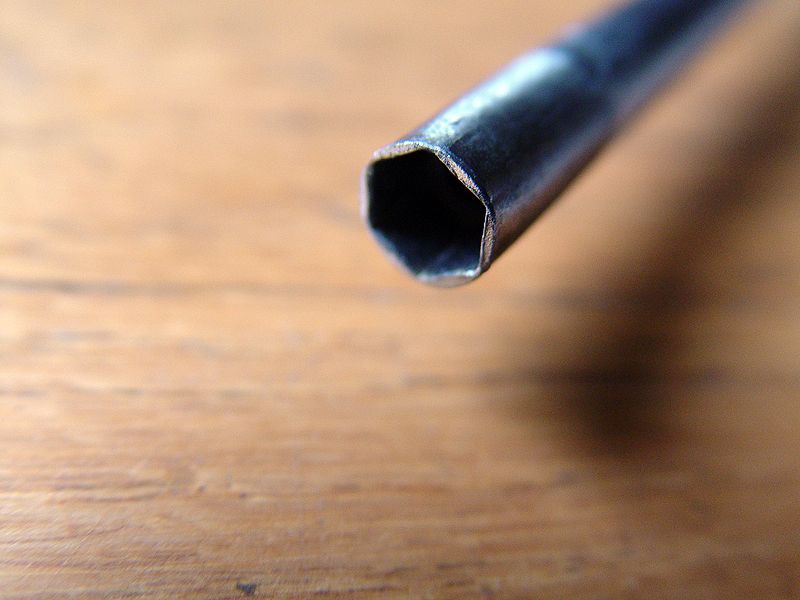
The modified tool allows me to undo decades of misadjustment. If I then remove the rods and find their threaded ends weakened or even twisted, I'll cut the threads off and shorten both tips of the headstock end--the lower tip must be about 5/8" longer than the upper tip, and it must be re-threaded. The upper tip needs to be ground to a slight bevel with the oblique angle of the bevel at the top, so it seats properly against the spacer block. Rods can be shortened like this once and sometimes twice without losing any of their effectiveness.
The most severe cases--and I've seen plenty of them--are '60s 12 strings and '70s and '80s 4001s. Since most players aren't techs, and most techs are not Rick techs, they will do exactly what John Hall is cautioning against--using a crescent wrench or socket wrench to apply torque to the rods. This kills the "feel" that a screwdriver-handled nutdriver like the X-Cellite gives you when adjusting your nuts (so to speak). Combine this with ignorance of the correct procedure for tightening that must be used with the old "hairpin" type truss rods, and it's a recipe for trouble of one of two types:
1. If the wood of the neck is soft or the fretboard to neck glue joint's strength is exceeded, the fretboard will begin to separate at or near the glue line. Many, many older Rick 12s and 4001s have this issue, and it's entirely due to ignorance of proper tools and procedures for neck adjustment.
For the record, before tightening the truss rod nuts to straighten the neck, the body of the instrument MUST be immobilized (padded clamp to padded flat surface) and the neck "persuaded" by hand to take its set, while tightening the nut with the proper tool using the other hand.
2. (And this is the issue with the OP's bass!) On some instruments you can develop so much torque on the rods by adjusting them too tight, that you can embed the spacer block into the neck wood, or, if the threads on the rods are weakened, you can snap the rod or cause it to bend into the floor of the adjustment pocket, which eliminates any space that might have been under the rod to allow the socket to slip under it to capture the nut. The threads are cut by hand on these older rods, not rolled, so they can be off-center and are often weakened by too much "persuading" with the wrong tools.
So, the OP's problem had less to do with Rickenbacker and everything to do with the ham-handed treatment that the instrument(s) had previously been subjected to. The X-Cellite tool is not sufficiently thin-walled to permit it to be used; this is neither the company's problem, nor the instrument's, nor the tool's. In cases like this, ingenuity is required, and if you don't have it, you're stuck.
In my tool chest I have 5 X-Cellite type tools of various wall thicknesses, ground down on a disc sander with some care. I have a lathe, but it's unnecessary to use that sort of time and precision. My favorite of these tools, has the outside diameter of the socket end ground to .355"
in diameter, with the tip ground to a slight bevel, too. I can tap this tool with a small hammer to seat it partway on the truss rod nut. The taper allows it to wedge itself between the nut and the floor of the cavity. I then place a strip of .060" steel across the truss rod adjustment cavity, and using the steel strip as a fulcrum and the tool as a lever, I gently urge the rod end straight again until I can fit the tool over the entire nut.
The tool I'm talking about is the second from the left in the photo, and it's not an X-Cellite, but a Valco S86 equivalent:
Below is an X-Cellite, ground to .335", seen from the end. It's the second smallest of the bunch. The smallest is already beginning to split at the vertices of the hex, but is paper-thin and still can be used in really stubborn cases:
The modified tool allows me to undo decades of misadjustment. If I then remove the rods and find their threaded ends weakened or even twisted, I'll cut the threads off and shorten both tips of the headstock end--the lower tip must be about 5/8" longer than the upper tip, and it must be re-threaded. The upper tip needs to be ground to a slight bevel with the oblique angle of the bevel at the top, so it seats properly against the spacer block. Rods can be shortened like this once and sometimes twice without losing any of their effectiveness.
-
jingle_jangle
- RRF Moderator
- Posts: 22679
- Joined: Wed Dec 22, 2004 6:00 am
- Contact:
Re: Does Rickenbacker supply wrenches to adjust your neck?
sloop_john_b wrote:Sepp, does that Cii have a flamey neck? My Stingray has a really flamey neck and I have to adjust it all the time.
Speaking of flamey necks and their need for adjustment, here's a shot of the headstock of the gorgeous flamey neck on my '68 Fender Villager 12-string acoustic. With the strings untensioned, the front of the headstock is parallel with the fretboard top surface!

It's tuned to "D" here, and I think you're looking at about 4 degrees of headstock tilt--toward the front! At "E" it's a full 5 degrees. I don't have this problem with straight-grained necks. Were this neck straight-grained or two or three-piece, this would not be an issue, but that's not how Fender builds their necks...


Re: Does Rickenbacker supply wrenches to adjust your neck?
I had always heard that flamed and other figured wood is not as strong as straight grained. You are confirming that.
The reason I had mentioned a lathe is that it takes a very steady hand and a consistant turning speed to grind it even like Paul's sample. You would most likely need to use a file or stone depending on the forging hardness. The tool I am using is something that I already had so I didn't purchase it just for this. The measurement of just under 0.400" will typically get you where you need to be as long as the rods aren't "tweaked". I didn't pay anywhere near $73.00 for it either. If I already had an Xcelite driver I would not hesitate to grind it. I have many Xcelite tools and they are good quality. Once again Paul is spot on.
The reason I had mentioned a lathe is that it takes a very steady hand and a consistant turning speed to grind it even like Paul's sample. You would most likely need to use a file or stone depending on the forging hardness. The tool I am using is something that I already had so I didn't purchase it just for this. The measurement of just under 0.400" will typically get you where you need to be as long as the rods aren't "tweaked". I didn't pay anywhere near $73.00 for it either. If I already had an Xcelite driver I would not hesitate to grind it. I have many Xcelite tools and they are good quality. Once again Paul is spot on.
"The best things in life aren't things."
-
jingle_jangle
- RRF Moderator
- Posts: 22679
- Joined: Wed Dec 22, 2004 6:00 am
- Contact:
Re: Does Rickenbacker supply wrenches to adjust your neck?
Look at the grain in the photos above, especially the second, end-on photo. Because of the primary direction of the figuring, it's as if the wood is end-grain--the weakest direction of wood grain when force is applied at a right angle to its grain.
Reminds me of the block of noodles that comes in Japanese noodle soup, taken right out of the package before you drop it into the boiling water...in essence, the grain is running the long way parallel to the neck's centerline, but because of the extreme curling of the grain, the string stress is actually being applied across the grain, if that makes any sense.
Reminds me of the block of noodles that comes in Japanese noodle soup, taken right out of the package before you drop it into the boiling water...in essence, the grain is running the long way parallel to the neck's centerline, but because of the extreme curling of the grain, the string stress is actually being applied across the grain, if that makes any sense.

Re: Does Rickenbacker supply wrenches to adjust your neck?
Kinda fits into the "It can be painful to be so pretty" modeken_j wrote:I had always heard that flamed and other figured wood is not as strong as straight grained.
Re: Does Rickenbacker supply wrenches to adjust your neck?
No sir, my TWO basses are a 2011 and a 2010 that are in AS NEW condition. My May, 2011 bass simply needed the G and D truss rod turned less than a quarter of a turn to give it a slight amount of relief because the neck was dead straight and I was getting considerable clank and buzz on the G string between the first and 4th frets. The title of my post was a question about whether or not Ric included a tool to adjust the neck....that is it....plain and simple. The answer is no and it has been adequately explained by Mr. Hall and others as to why they don't. But your post is excellent and your info on the tools and neck issues is great. Very informative.jingle_jangle wrote:So, the OP's problem had less to do with Rickenbacker and everything to do with the ham-handed treatment that the instrument(s) had previously been subjected to.