

Since recently getting my '77 Autumnglo, I've done a bit more digging around on the colour.
I'm aware there are some variations in shade, but I didn't realise they were in the same year?
This is on E-bay on the US at the moment - A '77.
http://www.ebay.co.uk/itm/1977-Rickenba ... _500wt_835
Here's mine - another '77 - looks totally different!
Autumnglo Shades
Moderators: rickenbrother, ajish4
-
bassduke49

- Senior Member
- Posts: 6580
- Joined: Wed May 14, 2003 5:00 am
Re: Autumnglo Shades
The Autumnglo/Walnut controversy lives on. There's no telling what contributed to the variations; different painter, different can of paint, different batch of paint, different manufacturer of paint, gloss overcoat, satin overcoat, amount of burst, and some were not burst at all! There are definitely different colors involved when you compare the "redder" brown to the "greener" brown over the years. There is even a lot of variation in the more recent Montezuma Brown. For more on Autumnglo/Walnut see:
viewtopic.php?f=2&t=390999
viewtopic.php?f=2&t=390999
Author: "The Rickenbacker Electric Bass - 50 Years As Rock's Bottom"
-
just_bassics
- Intermediate Member
- Posts: 1244
- Joined: Tue Aug 08, 2006 8:12 am
Re: Autumnglo Shades
I know this - AG is still one of my favorite finishes on a Ric bass. All variations look great, but the lighter, the better IMO. I just got a 79 FG 4001S, now a 77 -78 AG is the only one remaining on the wish list for basses. One of these days...
-
bassduke49
- Senior Member
- Posts: 6580
- Joined: Wed May 14, 2003 5:00 am
Re: Autumnglo Shades
Another factor to consider, Iain, is the camera and light source in these photos. The indoor studio shot of the eBay sample compared with your outdoor shot of your bass show significantly different hues, but that may vary with the camera's white balance and the "temperature" of the light. Sunlight is very "cool" light (lot of blue and ultraviolet), compared with, say, incandescent lights (very orange) or fluorescent (kinda green).
Author: "The Rickenbacker Electric Bass - 50 Years As Rock's Bottom"
Re: Autumnglo Shades
Thanks for that - great link as well!
I did a search beforehand, and couldn't find that!
Great help as always guys.
I did a search beforehand, and couldn't find that!
Great help as always guys.
1974 (February) 4001 JG
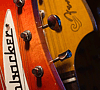
Re: Autumnglo Shades
My 1980 AutumnGlo (though not a bass)


Re: Autumnglo Shades
In 1966 the factory shipped a bunch of guitars to Rose Morris in the UK. According to Richard Smith's book, included in the shipments were 25 Fireglo six string guitars plus 100 guitars officially invoiced as "Autumnglo". The Autumnglo guitars included 25 model 1999 bass guitars plus 75 six string guitars. I've never seen one of those bass guitars pictured anywhere, but I've attached a picture below of what the colour looks like on a 6 string. It's possible none of the model 1999 guitars have survived, but if there are any left they would probably be amongst the rarest colour variation of any Autumnglo bass.
- Attachments
-

Re: Autumnglo Shades
...Iain, your's might as well be a FG! 
Re: Autumnglo Shades
It's not far from it, is it!
The headstock (and overall colour) is browner in the flesh....my poor camera work hasn't helped!
But is still very different to the more 'nutty' shades....
The headstock (and overall colour) is browner in the flesh....my poor camera work hasn't helped!
But is still very different to the more 'nutty' shades....
1974 (February) 4001 JG

Re: Autumnglo Shades
Quoting John Hall from 2.17.2000, "The earliest version of Autumnglo was simply shaded brown. The middle clear areas on most of these old guitars have yellowed, but wasn't originally apparent. The next version was just Fireglo laid on rather heavily. The last version was back to that original brown, but in a satin finish, while the gloss version of that color was designated Walnut. So when someone says Autumnglo, you always have to ask "WHICH Autumnglo"?"
"A Noble Instrument Must Be Nobly Regarded"
Re: Autumnglo Shades
ilan wrote:Quoting John Hall from 2.17.2000, "The earliest version of Autumnglo was simply shaded brown. The middle clear areas on most of these old guitars have yellowed, but wasn't originally apparent. The next version was just Fireglo laid on rather heavily. The last version was back to that original brown, but in a satin finish, while the gloss version of that color was designated Walnut. So when someone says Autumnglo, you always have to ask "WHICH Autumnglo"?"
The Rose Morris 1997 from 1966 (pictured above) was officially described by the factory as Autumnglo. I don't think that shading can be accurately described as "Fireglo laid on rather heavily"....there is no yellow/orange colouring in the centre at all. This Rose Morris Autumnglo goes from red in the centre to a very dark red (almost black) at the edges. That's why some people use the alternative non-factory designations Redburst or Moonglo for this colour to distinguish it from more common shades of Autumnglo.
I'd say the 1977 bass guitar pictured in the first post on this thread would be more accurately described as Fireglo laid on heavily (although it actually doesn't look that different from a regular Fireglo to me). I'm attaching a couple of pics of a 1967 370 I used to own which had a very rich Fireglo...but although that was a very dark red at the edges, it still has a clearly defined yellow/orange centre. This richer Fireglo shading was used on a lot of guitars around 1967 but AFAIK it was still designated as standard Fireglo.
- Attachments
-
-

Re: Autumnglo Shades
Regarding Fireglo, I believe I recall Mr. Hall stating some time ago that their formula never had any yellow or orange in it and it had always been just one translucent shade of red that was sprayed.
I think the many variations in Fireglo have resulted from the different ways it has been applied and the fact that many different Rickenbacker employees have done this job over the decades with their own varing techniques. I also believe that the underlying maple used has a profound effect on how the finished product looks. I have seen some unfinished maple that is almost white so that when red is applied you would get more of a pink look in the center. Then there is some maple that naturally has a distinct yellow or golden appearance and together with the red, would account for the more yellowish and orange shades. When you figure in the varing degrees of ambering or yellowing of the clear coats used due to age and/or enviornment, I can understand how so many variations have come to be. This is one of things I love about the Fireglo finish. When you add in the grain of the wood, these Fireglo guitars are like fingerprints as no two are exactly the same.
I think the many variations in Fireglo have resulted from the different ways it has been applied and the fact that many different Rickenbacker employees have done this job over the decades with their own varing techniques. I also believe that the underlying maple used has a profound effect on how the finished product looks. I have seen some unfinished maple that is almost white so that when red is applied you would get more of a pink look in the center. Then there is some maple that naturally has a distinct yellow or golden appearance and together with the red, would account for the more yellowish and orange shades. When you figure in the varing degrees of ambering or yellowing of the clear coats used due to age and/or enviornment, I can understand how so many variations have come to be. This is one of things I love about the Fireglo finish. When you add in the grain of the wood, these Fireglo guitars are like fingerprints as no two are exactly the same.
Re: Autumnglo Shades
Here's the back of mine - shows a different shade to the front -
- Attachments
-
-
1974 (February) 4001 JG
Re: Autumnglo Shades
Sounds right to me ...leaving natural maple with little or no colour in the centre of the front/back and then radiating out in darkening red is going to create that yellow/orange to red classic Fireglo shading effect. That's different to painting the centre of the guitar red and then radiating out in ever darker shades of red...that would be, er,..redburst!! Aka 1966 Autumnglo shading!!!krick wrote:Regarding Fireglo, I believe I recall Mr. Hall stating some time ago that their formula never had any yellow or orange in it and it had always been just one translucent shade of red that was sprayed.
The variations in FG shading over the years are significant as you point out. Here's another variation from the Sam Ash RoMo style guitars produced in 1987. Although this batch was officially described as Fireglo, in the flesh I'd say they are more brown than red in tone...dare I say more like Autumnglo!! still stunningly beautiful though!!!krick wrote: I think the many variations in Fireglo have resulted from the different ways it has been applied and the fact that many different Rickenbacker employees have done this job over the decades with their own varing techniques. I also believe that the underlying maple used has a profound effect on how the finished product looks. I have seen some unfinished maple that is almost white so that when red is applied you would get more of a pink look in the center. Then there is some maple that naturally has a distinct yellow or golden appearance and together with the red, would account for the more yellowish and orange shades. When you figure in the varing degrees of ambering or yellowing of the clear coats used due to age and/or enviornment, I can understand how so many variations have come to be. This is one of things I love about the Fireglo finish. When you add in the grain of the wood, these Fireglo guitars are like fingerprints as no two are exactly the same.

- Attachments
-
Last edited by k43rover on Mon Jul 09, 2012 11:59 am, edited 2 times in total.
Re: Autumnglo Shades
spongebob wrote:Here's the back of mine - shows a different shade to the front -
Looking at the back of the guitar, the edges look more like the dark cherry of the '67 Fireglo 370 I pictured...maybe a trick of the light/camera?? Iain, in the flesh does it look more cherry red or brown at the edges?