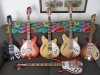
Larry, great job, man! You should be detective.
Congratulations, and thanks for every word you wrote on that mail.
I mean,... SO WE CAN SAY, WITHOUT ANY DOUBT, THAT THE FRETBOARD ON JOHN'S GUITAR 'RICKENBACKER 325 CAPRI 1958' DURING HIS BEATLEMANIA DAYS WAS ACTUALLY LACQUERED!!!!
I knew it. And I also knew my eyes (and my heart) were right.
I'll sleep better tonight.
So long. See you all.
"SO WE CAN SAY, WITHOUT ANY DOUBT, THAT THE FRETBOARD ON JOHN'S GUITAR 'RICKENBACKER 325 CAPRI 1958' DURING HIS BEATLEMANIA DAYS WAS ACTUALLY LACQUERED!!!!..."
No. I think we must take in to account the wear on the neck from extensive gigging in Hamburg, Liverpool etc....
What may look like a 'lacquered' finish on the fretboard is probably just well used/handled/played wood that has attained a natural sheen to it from use.
As far as it being lacquered at the factory, I seriously doubt it---the evidence points to Rickenbacker starting this sometime in 1959.
I have a 1957 Hofner Violin Bass that has a fretboard with a slight sheen to it---this is just from age and playing it over a long period of time. I can see where this condition may give the appearance of an overspray, but on John's '58 325 it's probably just honest wear and age.
Also, with consideration to what Larry says about Burns applying lacquer to the fretboard in 1963, I would wonder why Burns(or anyone) would do this, or rather what gave them the idea---Rickenbacker had no distribution in England until late 1963 at best; had they seen a later model Rickenbacker with a lacquered fretboard? Maybe DiMarino IS the guy that applied it, if it is there after all...
I am just curious as to what the motivation would be behind lacquering the fretboard, even at the point of re-fretting the guitar...I may be trying to dig too deep, LOL.
John,
I believe Larry's theory as the most accurate version of the story.
You say:
"What may look like a 'lacquered' finish on the fretboard is probably just well used/handled/played wood that has attained a natural sheen to it from use."
But what about this (and the pictures and films)?
Larry says:
"At this time the fretboard also becomes much lighter again as they must have cleaned it up real good before refretting."
By the way, John: if you play an instrument (and you say you do) you should know that a well worn-used fretboard becomes a darker colour, never lighter.
Then after you write:
"As far as it being lacquered at the factory, I seriously doubt it---the evidence points to Rickenbacker starting this sometime in 1959."
John, nobody's talking about that.
One more point:
"Also, with consideration to what Larry says about Burns applying lacquer to the fretboard in 1963, I would wonder why Burns(or anyone) would do this, or rather what gave them the idea..."
And who gave Lennon the idea to paint his guitar in 1962?
We still can't answer that question with an exact answer, can we?
"Maybe DiMarino IS the guy that applied it, if it is there after all..."
That seems impossible. Read what Larry wrote:
"Because it was worn I wouldn't think Ron DeMarino would have sprayed the fretboard as John didn't play it enough in the late 70's to wear the lacquer off the fretboard."
And Larry WAS there and actually SAW the guitar.
Finally:
"I am just curious as to what the motivation would be behind lacquering the fretboard, even at the point of re-fretting the guitar..."
Maybe one reason could be that if Burns did a lacquering on the fretboard, it wouldn't look so dirty anymore. After all that was Lennon's guitar, and as you says was "probably just well used/handled/played".
Someone, that I didn't know but wanna keep his name on secret, sent me this e-mail.
Judge yourselves:
"Lennon's fret board was refretted in September of 1963 after three solid years of HEAVY use - UNFINISHED!
Burns in 9/63 pulled John's badly WORN frets off his guitar, then, SHAVED the fretbord with a 'wood planer' removing several mm's of depth off the top.
New fret 'tang' slots were cut or 'deepened' to apply new 'Burns' frets.
Burns touched up Lennons guitar in Bison black and gave the guitar, including the fretboard, a final light overspary before it's refret.
Lennon's 1958 325 has African 'Paduak' rosewood as it's fretboard.
Paduak produces the richest ORANGE colour found when freshly cut!!!!!!!!!!
You MUST finish Padauk quickly to keep it's bright orange colour.
If you don't, it will turn dark!
This is why six months later (the Sullivan show) and 40 years later (NOW) that Lennons fretboard is still ORANGE!"
Yes, it's all very interesting. Marcelo, I am not really doubting what Larry had to say, just providing a different angle. A lot of what has been said in this thread is of a hypothetical nature, my own posts certainly not withstanding.
I am interested in everyone's take on what may have happened to the guitar over the years...it is what makes for an interesting debate.
By 1963, Rickenbacker WAS lacquering fretboards on all of their guitars/basses, but it wasn't a common practice of other guitar manufacturers/repair shops at the time....maybe Burns had picked up on this process when they were working on John's 325. After all, the guitar came in with an unfinished fretboard, but something motivated them to lacquer it. The obvious benefits are evident as was stated in the e-mail that was sent to Marcelo... Maybe they just didn't mask it off before they oversprayed the guitar....on we go.
John,
I agree with you.
Anyway, I think it´s an interesting fact that the guy who send me that mail with all that information, also said he owns a 1963 Burns Sonic electric guitar and it has a lightly oversprayed factory fretboard just like on John's Rick.
As far as I can see, all that about spraying laquer over the fretboard was a Burns 'trademark' of the time.
And talking about if that was really necessary... I think a fretboard can be shaved only a certain number of times, so a thin lacquer spray could protect it.
What do you think?
All the best.
Marcelo: This is just an example of what I am referring to. This photo have a substantial bounce from the 5th fret to the bridge pickup and really makes it impossible to speak to the lacquer for this reason.
Life, as with music, often requires one to let go of the melody and listen to the rhythm
OK Peter. That's YOUR opinion. But I disagree.
I've sent a reduced version of the pic because of the established limits to upload attachment.
By the way, I'd like to say something:
I just wanna have (or maybe share) the truth on this particular subject with the Rick 325 V81 fans on this wonderful forum.
But also, I've just started to think that maybe some people may think that what I really want to mean is, for example, that the 325 C58 RE-ISSUE is not a good guitar, or that isn't a perfect reproduction, or something like that.
Well... in that case the answer is NO.
I think that's a wonderful instrument, perfectly made.
But talking about 325 V81 in particular, things were only one way.
And I always prefer the truth.
Sincerely, Marcelo.
Peter wrote:
"This photo (the one on the left) have a substantial bounce from the 5th fret to the bridge pickup and really makes it impossible to speak to the lacquer for this reason."
The other picture is of my own guitar.
All the best.
Marcelo.
My .02 cents worth: My two '58 365s do not have lacquered fretboards. My '59 315 DOES NOT have a lacquered fretboard. My '59 345 DOES have a lacquered fretboard. All are factory original.
That being said, the non-lacquered fretboards are certainly oiled. They are NOT bare. Repeat, they are NOT bare.
Marcelo: The point I was trying to make is not that Lennon's guitar was never lacquered. I don't have the answer to this question.
Rather the photos, that have a lot of bounce from a flash make, it difficult to determine whether the shiny appearance is an artifact or the real thing.
I do not have evidence that it was never lacquered. I am just looking for more evidence. Two photos, from your post, each showing bounce from a flash does not provide sufficient evidence to conclude that Lennon's instrument was lacquered.
I do not see how your posts are at all critical of the 325C58.
I too want to learn about this guitar. I just think we need more information than we have at present to make a determination about whether it was lacquered at the factory or not.
Life, as with music, often requires one to let go of the melody and listen to the rhythm
Peter: OK. YOU don't have evidence, but what about this???
"Manabu and I looked over V81 very closely in Japan for about two hours. I checked my notes we took that day and it does have a very thin lacquer coat on the fretboard which was half worn off. It would be hard to see from any distance. Because it was worn I wouldn't think Ron DeMarino would have sprayed the fretboard as John didn't play it enough in the late 70's to wear the lacquer off the fretboard. I also think that the coach painter only sprayed the guitar black. I believe the fretboard had the thin lacquer applied by Burns Of London when they did the refret on John's '58 in 1963. At this time the fretboard also becomes much lighter again as they must have cleaned it up real good before refretting."
That was written by Larry Wassgren.
He WAS there and actually SAW the guitar.
Is not enough evidence for you?
What do you want?
The guitar itself?
Marcello: I recall Larry writing this and to me it establishes a light lacquering. This was and is sufficient for me. First hand inpection is surely evidence. I just don't think we can rely on photos alone. For me an important question has always been, was this finish original or not and when was it done?
Larry makes a good point about the refret. It may have been done in the fall of 1963. I have asked Les Andrews, who did the refret for Burns whether the company also lacquered the guitar at the same time. I hope he can remember and that he will respond.
John would have played the guitar for another six months. Would Burn's professional lacquer have rubbed off during this brief time? Perhaps.
I believe Larry is correct in his claim that the coach painter only sprayed the instrument black.
Finally Marcello, each one of us has our own interpretation. I am not saying that mine is correct and yours is not. Questioning and challenging each others' point of view makes the result stronger in my view. I very much appreciate your comments.
Life, as with music, often requires one to let go of the melody and listen to the rhythm