

Those who know me know that I have a '68 4001 that I blab on about as my best sounding Rick out of the 5 that I own, it's my go-to bass for recording, yadda yadda. But that's not to say that any other Rick bass isn't great sounding too. Fundamentally these basses are pretty much the same as they were since their introduction. There are variances in output, feel, and the volume & tone pots changed to 500v from 200v (or 250v, something like that) sometime in history, but once run through an amp, those variances can be compensated for and leveled out.
So I figured I'd do a sound test between my '68 4001 and '79 4001S and see how they vary in sound, and really see if the '68 is as "superior" an axe within my arsenal as I like to think it is. I ran both basses through the same amp with the gain adjusted for each bass so that they both got about the same level of grit, left the mic set up at exactly the same distance from the speaker - tried to level the playing field the best I could, basically.
I then played the same 5 basslines with each bass, alternating the takes so that one bass follows the other in the series and you can get a good A/B between the two for each line. All very scientific, I thought. But after recording this whole thing, it dawned on me that my '79 isn't even remotely stock, has parts removed, and has other parts on it that predate the '68 by a good few decades, so it's not truly a fair test between a '68 & '79. Plus, when all was said & done, I noticed that the strings on one bass were much newer sounding than the other.
So basically, what you're about to hear will be merely for shots & goggles as far as it's merit in proving anything. But it's still interesting to hear the difference between the basses. I leave you with two things - which bass sounds better, and can you tell which is the '68 and which is the '79?
Test 1 - The theme from 'Barney Miller' butchered quite sufficiently
Test 2 - untitled scale exercise I often warm up with
Test 3 - section of Siberian Khatru by Yes
Test 4 - untitled riff
Test 5 - section of Roundabout by Yes
Bass v Bass test
'68 4001 v '79 4001S sound test
Moderators: rickenbrother, ajish4
-
pflash4001

- Member
- Posts: 449
- Joined: Thu Dec 30, 2004 12:52 am
- Contact:
Re: '68 4001 v '79 4001S sound test
I also have a 1968 4001 (all original) and a 1979 4001 (mostly original...has a Sergio Silva toaster.) The 1968 has SIGNIFICANTLY lower output than my '79. Is this normal? I heard some guys here suggesting regaussing the horseshoe using rare earth magnets. When I called (I think it was StewMac) to order the magnets I mentioned what I was trying to do and they said unless I was REALLY sure what I was doing, they recommended I not do it because I could have ended up really screwing things up on that valuable pickup so I never did anything with it. I've never tested the p'ups with a multimeter. What would be the procedure for that? Can it be done with the p'ups still installed in the bass or would they have to be removed? It seems like of all my Rics, the '68 is the lowest output (by far) my '79 has a really nice solid CLANK to it, and my 1981 4000 grabs you by the face and GROWLS (in a very pleasant way, of course.) I'm just wondering about several issues I'm having with the 1968. The first is the output of the bass...the other is that there doesn't seem to be a happy medium. If I set the p'up height so that the open string rings free, once I get to about the 7th or 8th fret my E string is hitting the bobbin. If I set it up so the string can be fretted then the open string rattles against the horseshoe. One person suggested having the horseshoe sent in to someone like Lindy Fralin to have the bobbins shortened and then have the p'up rewound, but I have been reluctant to mess with that p'up. Any thoughts?
- Attachments
-
- '79 & '68 Headstocks side by side
-
- '79 & '68 side by side
-
- Dad and my 1979 (pre-Sergio toaster)
-
- My son and my 1979
-
- Me and my 1968 4001
Re: '68 4001 v '79 4001S sound test
I like the second Ric better. Chris Squire all the way.
The older the better they say so I guess the first bass is the '79 and the second the '68.
(both sound amazing though. well played!)
The older the better they say so I guess the first bass is the '79 and the second the '68.
(both sound amazing though. well played!)

Re: '68 4001 v '79 4001S sound test
Very well done Mark! Second one sounds best to me. The first has some wicked CLANK though!
Re: '68 4001 v '79 4001S sound test
Hey Javier - I used to have the same problems with my '68. Recharging the magnets on the horseshoe made all the difference. It brought the volume way up to a good balance with the output of the toaster. Previously I had to turn the toaster vol down about 25% just to get the HS audible in the mix, and then you're just barely getting anything to the amp! Now I can run both volumes at full and it sounds great to me, including the .0047 cap.
I initially had the HS mags recharged by a guy here in NYC who had a good machine to do it, but that meant disassembly. However, I did the manual magnet charge trick recently with some small strong magnets I picked up at Home Depot. It was effective; it's a nice DIY solution, BUT you can mess up the polarity of your HS mags if you apply the manual magnets the wrong way, which means applying "south" polarity to the "north" direction of your HS mags. However, the "damage" isn't permanent. You can re-align your polarity simply by recharging in the correct direction. At least I found this to be true during my test, your mileage may vary, as they say.
The way I could tell when I had the magnets on in the correct direction was by listening to the sound that the pickup made when applying the magnets while hitting an open string. When applied correctly, the HS pickup got much louder particularly in the upper-midrange, but when the magnets were applied with opposing N&S, the pickup took on a drastic midrange scoop sound, sort of like the way a Stingray bass sounds. The deceiving aspect of these hand-held magnets is that they will pull in either direction when applied to your HS mags, which is a weird property I don't understand. Usually when magnets are put together with reverse polarity, they physically repel each other. Not the case when applied to HS mags - the pull is equal in both directions. So once you figure out the correct way to put the mags on with the audible test, just mark them for future reference.
Here's the video of the test I did:
At 1:35 you can hear how I've got the magnets on the E/A HS reversed with the D/G side correct. Distinct difference in the tone!
I initially had the HS mags recharged by a guy here in NYC who had a good machine to do it, but that meant disassembly. However, I did the manual magnet charge trick recently with some small strong magnets I picked up at Home Depot. It was effective; it's a nice DIY solution, BUT you can mess up the polarity of your HS mags if you apply the manual magnets the wrong way, which means applying "south" polarity to the "north" direction of your HS mags. However, the "damage" isn't permanent. You can re-align your polarity simply by recharging in the correct direction. At least I found this to be true during my test, your mileage may vary, as they say.
The way I could tell when I had the magnets on in the correct direction was by listening to the sound that the pickup made when applying the magnets while hitting an open string. When applied correctly, the HS pickup got much louder particularly in the upper-midrange, but when the magnets were applied with opposing N&S, the pickup took on a drastic midrange scoop sound, sort of like the way a Stingray bass sounds. The deceiving aspect of these hand-held magnets is that they will pull in either direction when applied to your HS mags, which is a weird property I don't understand. Usually when magnets are put together with reverse polarity, they physically repel each other. Not the case when applied to HS mags - the pull is equal in both directions. So once you figure out the correct way to put the mags on with the audible test, just mark them for future reference.
Here's the video of the test I did:
At 1:35 you can hear how I've got the magnets on the E/A HS reversed with the D/G side correct. Distinct difference in the tone!
Re: '68 4001 v '79 4001S sound test
Nice shirt, Walker. And that's funny that the Barney Miller theme is apparently so ingrained in my head - I shot that vid about a year ago, and wasn't even thinking much about what I was playing.
Also note at 1:58 I've got both of the magnets on incorrectly. It sounds sort of cool with the midrange scoop effect, but yeah - that totally messed up the HS mags, which I corrected later by reapplying the manual magnets in the correct direction and letting them sit overnight. The last configuration I did in the video but only played a few notes on was the correct direction on both HS mags.
Back to the '68 v '79 "competition" - it appears that the consensus is unanimous thus far...
Also note at 1:58 I've got both of the magnets on incorrectly. It sounds sort of cool with the midrange scoop effect, but yeah - that totally messed up the HS mags, which I corrected later by reapplying the manual magnets in the correct direction and letting them sit overnight. The last configuration I did in the video but only played a few notes on was the correct direction on both HS mags.
Back to the '68 v '79 "competition" - it appears that the consensus is unanimous thus far...
Re: '68 4001 v '79 4001S sound test
By the way, Jav, on the string clearance issue - that used to be a problem with my '68, but one day I noticed that the HS mag on the D/G side had a wider gap than the E/A side, so I switched the mags to the opposite side of the bobbin and "problem solved" with the wider gap on the E/A side. Don't know if that solution applies to your situation... otherwise, I'm all for finding a solution that keeps the integrity of the original bobbin without chopping it down and rebuilding, but if you've exhausted all your options, that IS an effective solution and the bass will be a lot more freer to play. I do custom pickup rebuilds if you decide you want to go that route. I just did a 6-to-4 pole conversion on a pickup for Kevin Teed's RM bass.
viewtopic.php?p=776473#p776473
viewtopic.php?p=776473#p776473
-
pflash4001
- Member
- Posts: 449
- Joined: Thu Dec 30, 2004 12:52 am
- Contact:
Re: '68 4001 v '79 4001S sound test
Thanks for the info, Mark. This bass is nearly 45 years old. I don't want to jack it up by screwing up an attempt. Maybe if I had some guidance I might try it as I'd love to learn more about these basses and how to work with them. If that isn't a possibility and I decide to send it out, could you send me a PM letting me know how much it would cost to get the p'up regaussed and adjusted to give it more clearance? Thanks a lot for your help and info.
Re: '68 4001 v '79 4001S sound test
Sure thing.
(In general, I do a basic rewind for $40.)
(In general, I do a basic rewind for $40.)
Re: '68 4001 v '79 4001S sound test
And the winner of the '68 v '79 sound test by unanimous decision is…
the '79 4001S.
I kid you not. The bass that appeared to be the "superior vintage" bass was actually the '79, not the '68.
I'm crushed! The heretofore "champion" has been unceremoniously ousted!
But I guess it's not surprising that the '79 is the more Squire-sounding of the two. It's basically an RM 1999 more than it is a 4001. I think this test gives credence to the theory that the smaller body and dotted fretboard of the RM basses contribute to their distinct tone. Even acoustically the '79 has a brighter attack than the '68. Add to that: I specifically customized the '79 to sound like a '60s vintage bass by putting in the ancient horseshoe & old toaster and by moving the toaster closer to the neck. Plus, the '79 had the fresher strings, which really gave it an advantage in clarity and sustain. "It was a fixed fight!" says the '68 corner.
So there it is. But I still plan on using the '68 as my primary recording bass. It's still the more easy & comfortable bass to play. This exercise has given me some ideas on how to apply the EQ settings I used on the '79 to the '68.
the '79 4001S.
I kid you not. The bass that appeared to be the "superior vintage" bass was actually the '79, not the '68.
I'm crushed! The heretofore "champion" has been unceremoniously ousted!
But I guess it's not surprising that the '79 is the more Squire-sounding of the two. It's basically an RM 1999 more than it is a 4001. I think this test gives credence to the theory that the smaller body and dotted fretboard of the RM basses contribute to their distinct tone. Even acoustically the '79 has a brighter attack than the '68. Add to that: I specifically customized the '79 to sound like a '60s vintage bass by putting in the ancient horseshoe & old toaster and by moving the toaster closer to the neck. Plus, the '79 had the fresher strings, which really gave it an advantage in clarity and sustain. "It was a fixed fight!" says the '68 corner.
So there it is. But I still plan on using the '68 as my primary recording bass. It's still the more easy & comfortable bass to play. This exercise has given me some ideas on how to apply the EQ settings I used on the '79 to the '68.
Re: '68 4001 v '79 4001S sound test
Nice 
Have you got a pic of the 79? Would love to see it.
Cheers
Have you got a pic of the 79? Would love to see it.
Cheers
Re: '68 4001 v '79 4001S sound test
It's the same bass that Snoopy's playing in my profile shot.
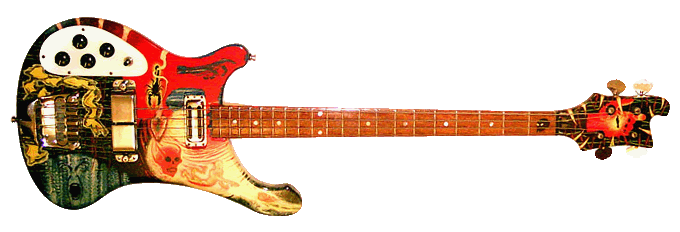
And the back:
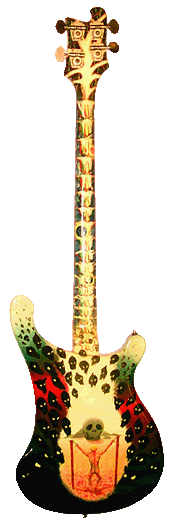
And the '68:
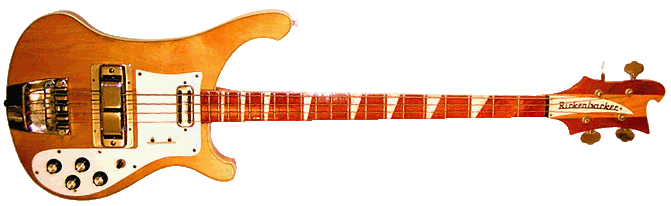
And the back:
And the '68:

Re: '68 4001 v '79 4001S sound test
I'm telling ya,the set-neck models have a certain je nais se qua,oui?
So,sorry if i missed it,but did you say the first bass in the sequence was the '68,followed by the '79? I personally liked both basses,but felt like the 2nd one was a bit cleaner sounding. It seemed like the first bass was hotter.
So,sorry if i missed it,but did you say the first bass in the sequence was the '68,followed by the '79? I personally liked both basses,but felt like the 2nd one was a bit cleaner sounding. It seemed like the first bass was hotter.
Re: '68 4001 v '79 4001S sound test
Good ear, Woodsey! Even though I tried my best to match the gain at the amp for both basses, the '68 (the first bass in the series) came out slightly grungier. The '79 is a little louder and has a LOT more treble, so I usually have to back off on gain & treble at the amp. Bringing it back up for the '68, I just overcompensated a little.
Re: '68 4001 v '79 4001S sound test
And like I said - the '79 had the newer strings that gave it and edge, too.