
hi all
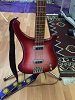
people my or may not remember the lefty 4001 i bought a while back , tatty JG but loved by me. Well thks to Owen and Jeff I pulled the rods and sorted them. Whilst there I decided a refinish would be good, which I have now done in tru oil and car polish! I will post some pics soon.
My question is so basic however as to make me appear the setup novice I am.
When you adjust the intonation do you play the note at fret 12, the harmonic at 12 or some other method. do you lengthen the string if it is pitching high or lower, can some one post an idiot guide to setup or point me to a post ive missed?
As a matter of interest if anyone who plays metal/rock would like to post their ideal setup I would love them for ever (ish)
ta people
A question on intonation
Moderators: rickenbrother, ajish4
-
jeff_ulmer
- Intermediate Member
- Posts: 873
- Joined: Sat Jan 18, 2003 6:00 am
- Contact:
Ideally you would use a tuner to do this. You can do it by ear comparing the 12th harmonic to the fretted twelfth, but it's pretty hard on a bass.
If your pitch is sharp, then the distance needs to be made longer (the easiest way to remeber that is to consider what happens when you shorten and lengthen the string length by fretting - shortening the string produces a higher pitch).
As for an ideal setup, I don't have one. I like to experiment!
If your pitch is sharp, then the distance needs to be made longer (the easiest way to remeber that is to consider what happens when you shorten and lengthen the string length by fretting - shortening the string produces a higher pitch).
As for an ideal setup, I don't have one. I like to experiment!
-
jwr2

I play the string open, play it on the 12th fret and play the 12th fret harmonic...all three should be the same on your tuner or at least as close as you can get em. If the fretted note is sharp, the string must be lenghtened by moving the string saddle BACK (toward the end of the body)..if it's flat then you move the saddle forward (toward the neck)...string height is subjective but standard for a fender is measured from the top of the fret to the bottom of the string at the 17th fret...2mm or 3/32" is standard..ricks are probably the same but I don't have a rick manual...maybe someone can chime in with the official rick recommendations... but I usually lower my strings until they buzz slightly and then back off a hair until the buzzing stops...of course you do this after you have adjusted the truss rods the way you want or per rick specs..

-
andybernard
Thankyou guys. Well Ive yanked the neck back and tweaked up the rods so I will have a go at setting the string height and intonating tonight. My neck setting system involved me pulling back the headstock and tweaking the rods up, which seems to have done the trick (more by luck than judgement.) thankyou all for your advice.
Using a digital (or strobe) tuner, tune the open string to pitch then play the note at the 12th fret. Move the saddle back (away from the nut) if the 12th fret note is sharp or move it forward if it is flat. Tuning to the 12th fret is usually enough but I also check a note on the upper frets. The note at the 19th fret is an easy choice because it is the double octave of the next lowest string. The 19th on the G string, for example, is a D.
I do it the same way as Ted, check both 12th and 19th, and even the 17th with the opposite string. Sometimes I use a tuner, other times my ears. By ear just listen for the beats. Loosen the string you are going to adjust before you turn the screw, do this one at a time. I use a small phillips head that can pretty much go in straight, use some pressure especially if it hasn't been done for a long time because they freeze up. The small screwdriver works better for me than the 90 degree screwdrivers that I bought for the job because you can get more leverage pushing straight.
I got an email from rick concerning string height: here it is...
"We don't officially publish a spec because this really should be set to
individual preference. That being said, this is what we use internally for
setup:
Guitar- Bass 5/64" Treble 3/64"
Bass- Bass 6/64" Treble 4/64"
FL Bass- Bass 7/64" Treble 6/64"
Don't ask me how 64ths became the standard- these things come from back in
tradition.
You can get a manual here:
http://www.rickenbacker.com/manual.pdf"
"We don't officially publish a spec because this really should be set to
individual preference. That being said, this is what we use internally for
setup:
Guitar- Bass 5/64" Treble 3/64"
Bass- Bass 6/64" Treble 4/64"
FL Bass- Bass 7/64" Treble 6/64"
Don't ask me how 64ths became the standard- these things come from back in
tradition.
You can get a manual here:
http://www.rickenbacker.com/manual.pdf"
One of their tech e-mailed me this summer when I took the 4001 out of mothballs and started playing bass again. He mentioned the "no offical specs" but suggested 4/32 on the bass side, and 3/32 on the treble.
My action was rather much higher than that, and my bridge saddle was whacked. That prevented the string height adjustment screws from working quite right. I also had an intonation screw sticking way out on the D, but the saddle was in the right spot, as the intonation was right on. Not sure how it got that way. :-\
I seated the saddle correctly, got the intonation screw on the D in the right place, and was able to adjust the string height. I ended up at 4/32 all around, seems pretty easy to play, but I'm sure it was closer to 3/32-2/32 when I has a kid.
I used an offset scewdriver, and I have to agree with Bob Young-a small straight one you can fit in there would be better. The upwards curve of the bridge behind the saddle insert makes it impossible to get in at a right angle with an offset.
Yes the Rick 4001 bridge is a little less than ideal, but set up properly it works well.
And the bass plays GREAT now...used it at practice earlier in the week and we're doing a gig tonight. ROCK N ROLL!!!!
My action was rather much higher than that, and my bridge saddle was whacked. That prevented the string height adjustment screws from working quite right. I also had an intonation screw sticking way out on the D, but the saddle was in the right spot, as the intonation was right on. Not sure how it got that way. :-\
I seated the saddle correctly, got the intonation screw on the D in the right place, and was able to adjust the string height. I ended up at 4/32 all around, seems pretty easy to play, but I'm sure it was closer to 3/32-2/32 when I has a kid.
I used an offset scewdriver, and I have to agree with Bob Young-a small straight one you can fit in there would be better. The upwards curve of the bridge behind the saddle insert makes it impossible to get in at a right angle with an offset.
Yes the Rick 4001 bridge is a little less than ideal, but set up properly it works well.
And the bass plays GREAT now...used it at practice earlier in the week and we're doing a gig tonight. ROCK N ROLL!!!!
Above e-mail is inactive. try ed_ardzinski@**** where **** is Hotmail.com or Yahoo.com. I tend to see things inthe hotmail box quicker...
So you CAN do it without having to take the strings off? Mine hasn't been done in 9 years...
Andy, interested to see pics of your bass as I refinished mine in "Tru Oil" as well (but no car polish) after discovering the beautiful grain in the buckle rash area. Mine has a bit of a dirt smudge where I rest my thumb against the body above the bridge pickup, but apart from that it looks good. I'm wondering if it should be waxed or something - its shiny in some areas and dull in others.
Andy, interested to see pics of your bass as I refinished mine in "Tru Oil" as well (but no car polish) after discovering the beautiful grain in the buckle rash area. Mine has a bit of a dirt smudge where I rest my thumb against the body above the bridge pickup, but apart from that it looks good. I'm wondering if it should be waxed or something - its shiny in some areas and dull in others.
mmm...sacrilicious