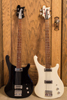
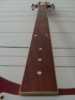
"This means that the truss cover on the v63 goes almost all the way to the end of the headstock. I haven't seen any 60's Ricks where that was the case."
Here's one! (Actually early '70s, but who's looking.)
The TRC on my '63 is nearly 6 1/2 inches long. Of course the early 60's models were subject to great variation so I don't think there is a fair way to describe a "typical" early 60's Rick bass. I think RIC used retained instruments from the company collection as examples for the V63. The body of the V63 is shaped very much like the '63 in the Smith book (which I believe hangs in the RIC museum). The shape of the one in the book differs from mine around the neck/body joint. All of the screws on mine are phillips head. I have never seen flat head wood screws on older Ricks. Maybe they had them but I have never seen it. The headstock of my '63 is nearly identical to the large 4003 headstock except that it has a squared edge rather than the rounded over edge of the modern basses. Speaking of headstocks. I saw some brand 4003's last weekend and the headstock shape suprised me. The contour of the cresting wave was thicker than usual and a whole lot less graceful. It was kind of stumpy looking. There were three in the store with that shape so I don't think is was just a fluke. Has anyone else noticed this?
The TRC cover screws on my 64 RM1999 are the slotted kind and a brass like colour. The same screws secure the toaster. Jeff has the same on his 67 4005WB TRC I believe.
The tuners are secured by slotted screws too, as is the horseshoe surround and I think the jackplate should be as well, although mine has phillips there.
I,m pretty certain the slotted screws are all original and the majority of 60,s Rose-Morris basses came with them.
However like Ted says, there are many individual nuances to these basses, given the human hand at work that day and one can certainly differ from the next...
The TRC cover screws on my 64 RM1999 are the slotted kind and a brass like colour. The same screws secure the toaster. Jeff has the same on his 67 4005WB TRC I believe.
The tuners are secured by slotted screws too, as is the horseshoe surround and I think the jackplate should be as well, although mine has phillips there.
I,m pretty certain the slotted screws are all original and the majority of 60,s Rose-Morris basses came with them.
However like Ted says, there are many individual nuances to these basses, given the human hand at work that day and one can certainly differ from the next...
Thanks for the photos guys. I wish I was good with a digital camera so I could provide some illustrations as well.
Jeffrey-I can't tell if your early 70's headstock above is the small early 70's type or large 60's type, but you're right! I think the 4005WB headstock above looks more typical of the 60's if there is such a thing.
Ted-I think we're talking about the same thing:
"Speaking of headstocks. I saw some brand (new)4003's last weekend and the headstock shape suprised me. The contour of the cresting wave was thicker than usual and a whole lot less graceful. It was kind of stumpy looking. There were three in the store with that shape so I don't think is was just a fluke. Has anyone else noticed this?"
The "scoop" taken out for the cresting wave seems to be smaller lately which makes the cresting wave "chubbier."(Maybe my melted chocolate analogy wasn't too good....Mmmmmm...chocolate...) I prefer the look of headstock on the 4005WB above(and the C64 even if it is upside-down!)
ok it's getting close to Christmas ... I am making my list ... how about a double neck 4004C and a 650D with walnut bodies and oil finish ... I bet Ted could make one out of the two ... ya I know it will never get built but I can dream ... or a bass with a 600 series body and headstock ...