
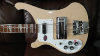
I posted a while ago about dead spots on the D string of my 4003, about frets 7,8 & 9 - the advice given was to tweak the truss rods slightly, which I've done and there does seem to be some improvement albeit the dead spots seem to have moved to fret 10!
I wasn't able to tighten the truss rods any more though as the neck is really flat and any more tightening introduces buzzing, so I slackened off the truss rod slightly on the G string side and really there was very little tension at all on it and basically now the nut is just about snugged in. The truss rod on the E side however has a few turns on it.
Is the neck ok with no tension at all on one truss rod or is there danger of the othe truss rod twisting the neck in any way?
Are unequal truss rod tensions ok?
Moderators: rickenbrother, ajish4

Re: Are unequal truss rod tensions ok?
Yep, it's fine - what the truss rods do is correct uneven tension in the wood after string pressure is applied.
I've seen wood so strong that no truss rod tension was needed at all, so if one side requires more tension than the other - it's basically a correction to strengthen the wood on that one side where it's needed.
That make sense?
I've seen wood so strong that no truss rod tension was needed at all, so if one side requires more tension than the other - it's basically a correction to strengthen the wood on that one side where it's needed.
That make sense?

Re: Are unequal truss rod tensions ok?
All of my new style truss rod necks have more tension on the E side than the G side.

Re: Are unequal truss rod tensions ok?
What would be the point of having two rods if the tension were always to be even? I guess you could argue additional strength or the placement of the tension but the design was specifically so that you COULD have uneven tension.
Re: Are unequal truss rod tensions ok?
Thanks for the replies guys, yes what you are all saying does make sense.
I might try releasing the E string side truss rod a bit more to see if I can totally get rid of those dead spots. When I tried the bass in the store there was quite a lot of relief in the neck and I purposely played every single fret on it, couldn't find a single fault, seems like I introduced the dead spots in getting the neck flat. I suppose there's always a chance as well when the neck is that flat in that the string may be just touching the next fret up the neck to the played note and preventing the string from vibrating freely and giving the false indication of a dead spot?
I might try releasing the E string side truss rod a bit more to see if I can totally get rid of those dead spots. When I tried the bass in the store there was quite a lot of relief in the neck and I purposely played every single fret on it, couldn't find a single fault, seems like I introduced the dead spots in getting the neck flat. I suppose there's always a chance as well when the neck is that flat in that the string may be just touching the next fret up the neck to the played note and preventing the string from vibrating freely and giving the false indication of a dead spot?
Re: Are unequal truss rod tensions ok?
And that's the beauty of the two rod system.johnhall wrote:What would be the point of having two rods if the tension were always to be even? I guess you could argue additional strength or the placement of the tension but the design was specifically so that you COULD have uneven tension.
Re: Are unequal truss rod tensions ok?
Often dead spots are fret wear , if you get someone who plays of the A string on the E string and in that block a lot like blues or prog rock players you get fret wear around 4-9th fret and little elsewhere.
Be sure you are not trying to torque out worn frets, put an edge along the neck and measure each fret to look for low frets in comparison to the finger board.
If they are low in one spot they can be stoned flat with the right tool and the neck tensioned straight and the dead spots will be gone.
I had this on a 4003's, levelled the frets a bit and it now rings like a church bell.
Be sure you are not trying to torque out worn frets, put an edge along the neck and measure each fret to look for low frets in comparison to the finger board.
If they are low in one spot they can be stoned flat with the right tool and the neck tensioned straight and the dead spots will be gone.
I had this on a 4003's, levelled the frets a bit and it now rings like a church bell.
Re: Are unequal truss rod tensions ok?
Thanks for the reply Mark.
The bass is fairly new so absolutely no fret wear at all yet, I understand what you're saying though.
The bass is fairly new so absolutely no fret wear at all yet, I understand what you're saying though.
-
clankchris
- Member
- Posts: 279
- Joined: Fri May 27, 2005 6:43 pm
Re: Are unequal truss rod tensions ok?
I can finally stop worrying about this and sleep at night now. Thanks, John.johnhall wrote:What would be the point of having two rods if the tension were always to be even? I guess you could argue additional strength or the placement of the tension but the design was specifically so that you COULD have uneven tension.


Re: Are unequal truss rod tensions ok?
I understand what John is saying in that the 2 truss rods work in tandem to achieve the correct overall tension on the neck, however on my 4003 the one truss rod isn't doing anything at all, it needs to be that loose that it isn't actually doing anything at all, I've basically tightened it just enough so that the rod doesn't rattle or vibrate when played.
So, although it is a dual truss rod bass there's only the one truss rod that is doing any work!
So, although it is a dual truss rod bass there's only the one truss rod that is doing any work!
Re: Are unequal truss rod tensions ok?
I've had this also on a couple basses, Steve.Baker69 wrote:I understand what John is saying in that the 2 truss rods work in tandem to achieve the correct overall tension on the neck, however on my 4003 the one truss rod isn't doing anything at all, it needs to be that loose that it isn't actually doing anything at all, I've basically tightened it just enough so that the rod doesn't rattle or vibrate when played.
So, although it is a dual truss rod bass there's only the one truss rod that is doing any work!
Re: Are unequal truss rod tensions ok?
I'm wondering if this situation is the reason for me not being able to tweak out the dead spots on my D string?
Re: Are unequal truss rod tensions ok?
This does happen on occasion, when the wood of the neck or fingerboard (or usually both together) are conspiring against the string tension. Of course, it can come from choice of strings as well.Baker69 wrote:I understand what John is saying in that the 2 truss rods work in tandem to achieve the correct overall tension on the neck, however on my 4003 the one truss rod isn't doing anything at all, it needs to be that loose that it isn't actually doing anything at all, I've basically tightened it just enough so that the rod doesn't rattle or vibrate when played.
So, although it is a dual truss rod bass there's only the one truss rod that is doing any work!
But think about it- if one of these guitars had only one central rod, the guitar would be toast. Having two closer to the edges of the board gives you so much more adjustability, even if one isn't used much. An unused rod doesn't hurt anything to be there but could be sorely missed if it weren't.

Re: Are unequal truss rod tensions ok?
interesting , my '08 4004cii is just like that , E side is adjusted , G side is just tightened enough not to rattle . Neck is perfect .It's been like that all these years

Re: Are unequal truss rod tensions ok?
My 1975 4001 is the same. All the tension is on the E side rod. This is the only way I can get roughly similar relief on both sides of the neck. Whatever I do there is always slightly more relief on the E side, but this is no bad thing as the E string is the only one that rattles against the upper frets when I play with a pick at the lower frets and therefore needs a little bit more relief. For me uneven rod tension doesn't affect tone or dead spots. In fact currently my bass seems more alive than ever with the uneven tension.