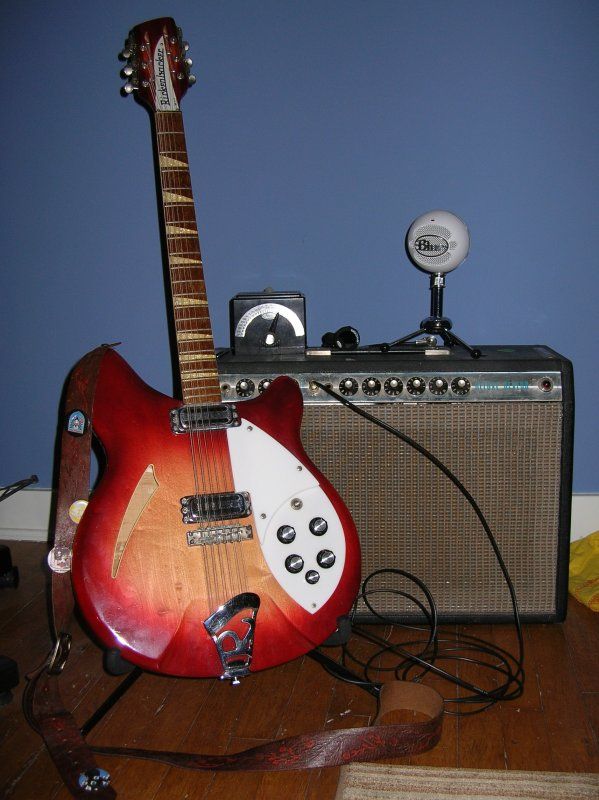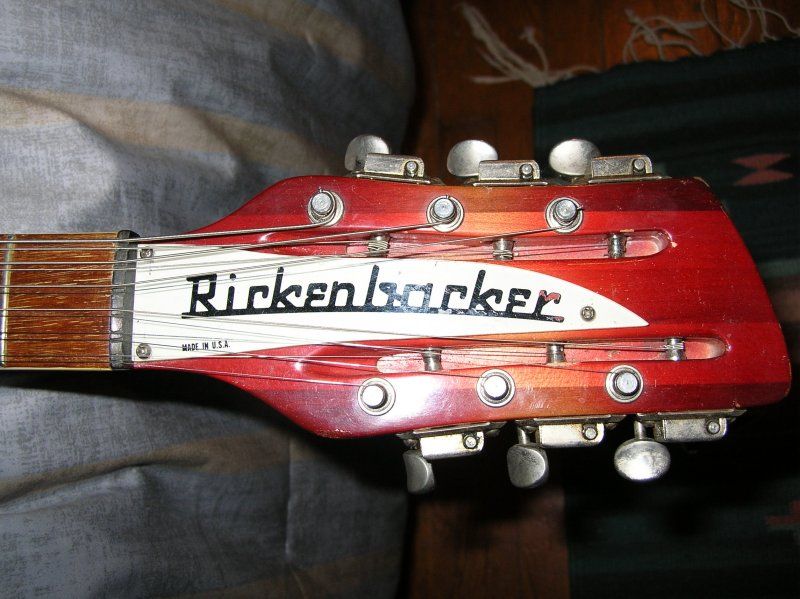

His 1966 Fireglo 360/12 was among his prized possessions; and he left it for me in his will. It is very sad he is no longer with us, he was far too young to die at the mellow age of 62. This guitar is now mine to love and cherish, and his memory will always live on within it.
I joined this forum for this very reason - being the owner of a '66 Rick 12 is a new experience for me (I mostly play PRS or Tele-type guitars) and I intend to play it as it was designed. I've already started updating my repertoire around the great, early Beatles, Who, and Byrds songs that are so uniquely defined by the distinctive sound of this amazing guitar.
Already, however, there are a couple of issues that I need to address to bring this guitar into 'player' condition. I look forward to learning a lot from the members here about care and feeding of a great instrument like this.
The first issue that came to light is a 'fret crash' at the 11th fret on the 1st string pair. It's unfortunate, because that note is needed for the lead solo in the Byrds version of Dylan's My Back Pages. I can compensate by playing the 2nd string pair on the 16th fret, but . . .
The other issue that just materialized is more troubling: the low octave A string (I have it strung in 'Rickenbacker format' with the lower octave strings above the higher) has just started to pop out of its guide in the nut. This is not cool.
So, as part of my introductory post, I have a couple questions for the knowledgeable Rick lovers that frequent this forum: 1) Is a refret a common procedure for older Rick 12 strings? 2) Is it a common problem that the nut starts to fail?
Regarding the nut, I'm not sure what to think about what I see. It looks to be made of rosewood and the grooves are angled. It almost seems that even the strings that have tuning keys on the treble side are angled in the opposite direction. As I type this, I'm not looking at the guitar, but that was my first impression. I'd be interested to hear what a typical '66 12 string nut should look like. I don't recall seeing any difference in the groove widths between the pairs of strings.
Of course, I have no information on the history of this guitar and when I received it, it was strung like a traditional 12 string, with the higher octave strings on top (with 3 broken strings - one E, one B, low G). I don't know if the nut was modified or replaced, although it looks suspiciously low.
So anyway, 'Hello', and I look forward to learning a lot more about this great guitar. I fear I'll have to give it up for a while when I deliver it to my favorite luthier who does not necessarily have all the time he needs to do all of the work needed in his shop