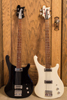
I have seen this image but not sure how this works. Is it a curved slot?

Thank you for any info.
Cheers Peter.

Moderators: rickenbrother, ajish4

How's that work with a single rod/unit?collin wrote:It's a dual-action rod.
Meaning, turn the nuts clockwise to make the neck move one way (bowed) and turn the nut counterclockwise to make it move the opposite way (relief).
The same way.jps wrote:How's that work with a single rod/unit?collin wrote:It's a dual-action rod.
Meaning, turn the nuts clockwise to make the neck move one way (bowed) and turn the nut counterclockwise to make it move the opposite way (relief).
So, you're saying that if I were to turn the truss rod nut(s) CCW a bunch, the nut(s) won't just come off the end of the truss rod, but will actually induce more relief (forward bow on the neck)? This should work even with no strings on the instrument.collin wrote:The same way.jps wrote:How's that work with a single rod/unit?collin wrote:It's a dual-action rod.
Meaning, turn the nuts clockwise to make the neck move one way (bowed) and turn the nut counterclockwise to make it move the opposite way (relief).


Yeah I do not think a static rod, even two of them, can adjust both ways. Tightening puts pressure on the washer and pulls the curve flatter giving backbow. If there is enough string pressure or if the neck was forced into a back bow when it was glued then releasing the rods may result in forward bow, or relief. If there is no pressure forward the nut will just relax, come off, and the rod will not move. This is the example of a one way rod.collin wrote:It's a dual-action rod.
Meaning, turn the nuts clockwise to make the neck move one way (bowed) and turn the nut counterclockwise to make it move the opposite way (relief).
The old style rods were a single action. Flex the neck back by hand when the rods are loose and then tighten the nuts to hold the rod in place wherever you put it manually.
The modern style rods are vastly superior in every way.

That was way more concise than my explanation - well done (serious)collin wrote:Sure, might be a matter of semantics or technicality.
I just mean that the old style Rick truss rods require bending by hand and the truss rod can only hold the neck wherever you set it (for backbow). But the "modern" Rick truss rods can either induce backbow turning it clockwise, or allow relief (via the string tension pulling neck forward) by turning the nuts clockwise.
Dual rods just allow you to dial-in more (or less) relief on either the treble or bass side of the fretboard.