
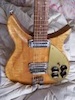
I recently bought a 1964 combo 1000. I’m having trouble keeping the bridge stable. It wants to slide forward.
The main trouble could be the string angle over the bridge is quite a sharp angle and the string plate is so low. Any tips?
Combo 1000 bridge moving
Moderators: rickenbrother, ajish4
Re: Combo 1000 bridge moving
I never heard of a Combo 1000; had to search one out and found this 1963, which must be about the same as yours…
https://cartervintage.com/shop/rickenba ... rIdxPShIM1
Some guys, including myself, have a similar Sorkin Bow tie bridge (simply rests on the face of the guitar, held in place with string pressure) and I read of three options (that I can recall) to keep the bridge from sliding out of place: a thin layer of cork (I had no idea where to get this, and also did not think it would work the best), double-sided tape (I wasn’t confident that this would not mar the guitar finish; no go), thin rubber sheet…. (I elected to use a piece of nitrile glove, thinking it would be inert). The nitrile didn’t work that well; I just let it go because this bridge on a 325v59 is just about touching/bumping up against the bridge pickup anyway. If your guitar has that big pick guard and the bridge sits on that, then I think you can try just about anything. I’d go with some regular (Scotch) double-sided tape. Thin tape won’t alter the tone, diminish transfer of energy, etc. It will be a small hassle intonating, but can be fun, rewarding at least.
https://cartervintage.com/shop/rickenba ... rIdxPShIM1
Some guys, including myself, have a similar Sorkin Bow tie bridge (simply rests on the face of the guitar, held in place with string pressure) and I read of three options (that I can recall) to keep the bridge from sliding out of place: a thin layer of cork (I had no idea where to get this, and also did not think it would work the best), double-sided tape (I wasn’t confident that this would not mar the guitar finish; no go), thin rubber sheet…. (I elected to use a piece of nitrile glove, thinking it would be inert). The nitrile didn’t work that well; I just let it go because this bridge on a 325v59 is just about touching/bumping up against the bridge pickup anyway. If your guitar has that big pick guard and the bridge sits on that, then I think you can try just about anything. I’d go with some regular (Scotch) double-sided tape. Thin tape won’t alter the tone, diminish transfer of energy, etc. It will be a small hassle intonating, but can be fun, rewarding at least.
Re: Combo 1000 bridge moving
Thanks for the ideas.
Re: Combo 1000 bridge moving
So, this morning I’m thinking that (if this were my guitar) I would simply paint some rubber cement on the bottom surface of the bridge. The resin/plastic pick guard shouldn’t be chemically affected/marred by the rubber cement, and cleans up easily and cleanly.
It’s unlikely that the guitar shown in the link I provided is accurately intonated as we see it, with the bridge “conveniently’ backed up against the tailpiece. Before cementing the bridge I’d experiment an determine the exact position for best intonation. Then I’d cut out a thin cardboard “L” to place across the entire top (upper/forward edge) and one side of the bridge. Lay the “L” down so that both legs are touching the bridge in its proper location and tape that cardboard in place. Now the strings can be removed. Apply the rubber cement to the underside of the bridge; I think it should be allowed to dry somewhat…? Now you can easily and accurately position (reposition) the bridge in the exact location you want it using that cardboard L as a positional guide. Press the bridge into place. Clean up whatever excess cement oozes out, but if the cement is thin and allowed to mostly set up first, there shouldn’t be any excess. Let the cement set up and remove the cardboard. (Any remaining cement can be easily removed with you fingernail or a plastic “edge” of some sort; be gentle as to no scratch the pick guard.). Leaving that cardboard in place when restringing will provide some bracing in case the bridge might try to move. Well, my early morning thought.
It’s unlikely that the guitar shown in the link I provided is accurately intonated as we see it, with the bridge “conveniently’ backed up against the tailpiece. Before cementing the bridge I’d experiment an determine the exact position for best intonation. Then I’d cut out a thin cardboard “L” to place across the entire top (upper/forward edge) and one side of the bridge. Lay the “L” down so that both legs are touching the bridge in its proper location and tape that cardboard in place. Now the strings can be removed. Apply the rubber cement to the underside of the bridge; I think it should be allowed to dry somewhat…? Now you can easily and accurately position (reposition) the bridge in the exact location you want it using that cardboard L as a positional guide. Press the bridge into place. Clean up whatever excess cement oozes out, but if the cement is thin and allowed to mostly set up first, there shouldn’t be any excess. Let the cement set up and remove the cardboard. (Any remaining cement can be easily removed with you fingernail or a plastic “edge” of some sort; be gentle as to no scratch the pick guard.). Leaving that cardboard in place when restringing will provide some bracing in case the bridge might try to move. Well, my early morning thought.
Re: Combo 1000 bridge moving
The bridge/tailpiece (B/T) is not sitting on top of the pickguard (PG). The PG is cut out in that area with the B/T "poking through"; therefore, the B/T is directly on the body, itself.maxwell wrote: Thu Aug 22, 2024 7:37 pm I never heard of a Combo 1000; had to search one out and found this 1963, which must be about the same as yours…
https://cartervintage.com/shop/rickenba ... rIdxPShIM1
Some guys, including myself, have a similar Sorkin Bow tie bridge (simply rests on the face of the guitar, held in place with string pressure) and I read of three options (that I can recall) to keep the bridge from sliding out of place: a thin layer of cork (I had no idea where to get this, and also did not think it would work the best), double-sided tape (I wasn’t confident that this would not mar the guitar finish; no go), thin rubber sheet…. (I elected to use a piece of nitrile glove, thinking it would be inert). The nitrile didn’t work that well; I just let it go because this bridge on a 325v59 is just about touching/bumping up against the bridge pickup anyway. If your guitar has that big pick guard and the bridge sits on that, then I think you can try just about anything. I’d go with some regular (Scotch) double-sided tape. Thin tape won’t alter the tone, diminish transfer of energy, etc. It will be a small hassle intonating, but can be fun, rewarding at least.
Re: Combo 1000 bridge moving
Well, Jeff, I understand what you're saying, but assuming the 1963 example that I linked is the same as a 1964 as far as the bridge/tailpiece go, I cannot for the life of me see any hint of a space around that assembly. The cutout is easily noticeable around the pickup, but it sure *looks* like the assembly is sitting on top of the pickguard; if there is a cutout there, it must be extraordinarily precise. Also, the OP is concerned about the bridge sliding, which implies that the bridge is a separate entity that is able to slide, i.e., sitting on top of the pickguard and not within a confining cutout.
This morning, I revisited jsm610's thread and his SN Decoder:
viewtopic.php?t=418049
Go to the decoder via his link. Just below the artwork are photos that are viewed one at a time via embedded "arrow" links withing each photo. Using the dots just below the photo frame as a numerical guide, select the third photo which is a close-up example of this bridge/tailpiece, which he calls (more appropriately, I think) a "Bridge Plate" (photo: "Bridge Plate Serial Number Example"). This example shows that bridge plate sitting within an easily recognizable cutout.
So it seems you are correct, although no matter how carefully I look, I can't see any cutout on the 1963 example. Of course, having the bridge plate mounted directly on the body will allow for more consistent neck angle and string action; I can't see how the bridge height is adjusted; no obvious thumb wheels; maybe screw adjustments, like a typical Strat pickup. Having varying degrees of pick guard thickness would raise havoc with those setup parameters.
I am fixed on the Joe's concern about the bridge sliding. How is this possible if the assembly is sitting within a cutout, regardless if there is a physical joining of the bridge and the plate? I'm hoping Joe (the OP) will clarify.
(It seems that both the bridge location and bridge height are predetermined and fixed. "We've done this for you, so you don't have to be concerned about anything. Enjoy your new guitar!")
This morning, I revisited jsm610's thread and his SN Decoder:
viewtopic.php?t=418049
Go to the decoder via his link. Just below the artwork are photos that are viewed one at a time via embedded "arrow" links withing each photo. Using the dots just below the photo frame as a numerical guide, select the third photo which is a close-up example of this bridge/tailpiece, which he calls (more appropriately, I think) a "Bridge Plate" (photo: "Bridge Plate Serial Number Example"). This example shows that bridge plate sitting within an easily recognizable cutout.
So it seems you are correct, although no matter how carefully I look, I can't see any cutout on the 1963 example. Of course, having the bridge plate mounted directly on the body will allow for more consistent neck angle and string action; I can't see how the bridge height is adjusted; no obvious thumb wheels; maybe screw adjustments, like a typical Strat pickup. Having varying degrees of pick guard thickness would raise havoc with those setup parameters.
I am fixed on the Joe's concern about the bridge sliding. How is this possible if the assembly is sitting within a cutout, regardless if there is a physical joining of the bridge and the plate? I'm hoping Joe (the OP) will clarify.
(It seems that both the bridge location and bridge height are predetermined and fixed. "We've done this for you, so you don't have to be concerned about anything. Enjoy your new guitar!")
Re: Combo 1000 bridge moving
Frankly, without pics from the OP of the actual guitar in question, we're just yelling at clouds.maxwell wrote: Mon Aug 26, 2024 1:34 pm Well, Jeff, I understand what you're saying, but assuming the 1963 example that I linked is the same as a 1964 as far as the bridge/tailpiece go, I cannot for the life of me see any hint of a space around that assembly. The cutout is easily noticeable around the pickup, but it sure *looks* like the assembly is sitting on top of the pickguard; if there is a cutout there, it must be extraordinarily precise. Also, the OP is concerned about the bridge sliding, which implies that the bridge is a separate entity that is able to slide, i.e., sitting on top of the pickguard and not within a confining cutout.
This morning, I revisited jsm610's thread and his SN Decoder:
viewtopic.php?t=418049
Go to the decoder via his link. Just below the artwork are photos that are viewed one at a time via embedded "arrow" links withing each photo. Using the dots just below the photo frame as a numerical guide, select the third photo which is a close-up example of this bridge/tailpiece, which he calls (more appropriately, I think) a "Bridge Plate" (photo: "Bridge Plate Serial Number Example"). This example shows that bridge plate sitting within an easily recognizable cutout.
So it seems you are correct, although no matter how carefully I look, I can't see any cutout on the 1963 example. Of course, having the bridge plate mounted directly on the body will allow for more consistent neck angle and string action; I can't see how the bridge height is adjusted; no obvious thumb wheels; maybe screw adjustments, like a typical Strat pickup. Having varying degrees of pick guard thickness would raise havoc with those setup parameters.
I am fixed on the Joe's concern about the bridge sliding. How is this possible if the assembly is sitting within a cutout, regardless if there is a physical joining of the bridge and the plate? I'm hoping Joe (the OP) will clarify.
(It seems that both the bridge location and bridge height are predetermined and fixed. "We've done this for you, so you don't have to be concerned about anything. Enjoy your new guitar!")

Re: Combo 1000 bridge moving
Yeah, but it's sort of refreshing having something other than bass guitars to comment on... yada, yada, yada
Re: Combo 1000 bridge moving
I don’t have an image hosting site. But the bridge works alot like an arch top guitars bridge. It straddles the string tailpiece and sits on the guitar body in a routed slot below the pickguard. Just like 425 and 450s of that era.
Re: Combo 1000 bridge moving
You don't need an image hosting site, you can easily attach the photos directly from your computer.

Re: Combo 1000 bridge moving
First, the Bacon and Day book doesn't have it as a "Combo" 1000; rather, it is referred to as "Model 1000" (which is what I have seen these described as in the past) ...
This Reverb listing is the first time I have seen it referred to as a "Combo".
Second, I have three guitars that have the same bridge/tailpiece/plate hardware:
Here's a close-up of the 460 bridge area:
None of these have a "slippery bridge" that will move easily on its own; I have given the 460 bridge a substantial bump and it did move a bit (required repositioning for correct intonation) but no problems otherwise.
In my experience as a scientist,it typically takes some sort of lubrication to get metal-on-metal surfaces under pressure to move.
To reiterate what has already been said, we need pictures to diagnose this.
- Bacon & Day p 14-15
Second, I have three guitars that have the same bridge/tailpiece/plate hardware:
- 1966 Ryder Model 1000 FG
- 1999 450v63 JG
- 1981 460 BG
- 460 bridge area
In my experience as a scientist,it typically takes some sort of lubrication to get metal-on-metal surfaces under pressure to move.
To reiterate what has already been said, we need pictures to diagnose this.
It is better, of course, to know useless things than to know nothing. - Seneca
Re: Combo 1000 bridge moving
I’ve been casually looking for a photo of a disassembled assembly, or maybe an exploded diagram. I noticed that Winfield sells some parts. Here’s one, and it floats:
https://www.winfieldvintage.com/product ... ridge-base
(for post-1962 models, incl. model 1000)
https://reverb.com/item/25288121-tailpi ... 0-1000-etc
https://reverb.com/item/12234867-wound- ... 25-450-460
https://www.winfieldvintage.com/product ... ridge-base
(for post-1962 models, incl. model 1000)
https://reverb.com/item/25288121-tailpi ... 0-1000-etc
https://reverb.com/item/12234867-wound- ... 25-450-460
Re: Combo 1000 bridge moving
I was aware that Winfield had these, but it was a while ago, and IIRC at that time the tailpiece/plate was the "Model 430" style with four indentations for the vertical adjustment screws of a standard RIC bridge. The 430 I once had had this style of tailpiece/plate (of course):
- 1975 RIC 430 JG close up
It is better, of course, to know useless things than to know nothing. - Seneca