
The scale lengths as far as I can gather are 33.25 for fretted and 33.5 for fretless.
I’ll get the pictures tomorrow.
I have strayed somewhat from whether it is a RM1999 or a 4000s though. Any light to be shined on this
RM1999 vs 4001S
Moderators: rickenbrother, ajish4
Re: RM1999 vs 4001S
teeder wrote: Thu Jan 09, 2025 2:51 pm Can you show the whole back of the neck, especially near the nut end?
What about the scale makes you think it was originally fretless?
- Attachments
-
-
-
-
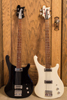
Re: RM1999 vs 4001S
Doesn't look refinished but that earlier closeup looked pretty rough.
Re: RM1999 vs 4001S
Just spoke with the previous, previous owner again and he told me he found it on the wall of Mega Music Studio here in Johannesburg rattle can painted black with the wrong bridge and bridge pickup but otherwise complete. Tells me he stripped it and found the remnants of fireglow underneath so painted it that. He ordered a period pickup and bridge but the post lost them so he put it one side for 10 or so years then traded it with another friend who did nothing with it for another 5 or 6 years and now I have it. One of them must have bought the China Mall bridge at sometime.
Re: RM1999 vs 4001S
[*]That's a very interesting bass! The 3 piece headstock and the rounded heel where the neck meets the body look correct for a mid to late 1960s bass. Is it possible to post a picture showing all of the routing underneath the pickguard, including the neck pickup cavity? That could provide some additional clues.
I agree, it does look like the fingerboard has been replaced, and the fingerboard appears to be considerably thicker than typical. Factory fretless electric basses that were manufactured before 1970 are extremely unusual and it was a fairly common modification to see, post Jaco. Rickenbacker certainly has made some interesting exceptions so anything is possible.
I agree, it does look like the fingerboard has been replaced, and the fingerboard appears to be considerably thicker than typical. Factory fretless electric basses that were manufactured before 1970 are extremely unusual and it was a fairly common modification to see, post Jaco. Rickenbacker certainly has made some interesting exceptions so anything is possible.
Last edited by bassdroid on Fri Jan 10, 2025 5:48 am, edited 1 time in total.
Re: RM1999 vs 4001S
Pots and serial number goes to Feb 1966.
I was trying to se if it was a RM1999 but it’s turned into a fretless discussion.
I am going to get my friends 4001 and do some measurements.
I was trying to se if it was a RM1999 but it’s turned into a fretless discussion.
I am going to get my friends 4001 and do some measurements.
- Attachments
-
-
-
-
Re: RM1999 vs 4001S
Thanks, the routing on the body looks quite similar to that on my restored 1966 RM1999. The channel between the neck pick up and the control cavity would have been routed with a forstner bit. Yours looks like it was worked on pretty heavily, perhaps routed twice? But it is the right size and shape. The cavity for the neck pickup looks correct too, and I have a very similar marking in the control cavity. Getting ready for work so I will post pictures later.
Re: RM1999 vs 4001S
At this point, I don't think anyone could positively say "Yes, it's a RM1999".I was trying to se if it was a RM1999 but it’s turned into a fretless discussion.
Which gets us to the "Fretless" discussion.
IMO, a '60's fretless Rick would be much rarer than even a RM1999.
That's why the interest.
Put me down as: "Probably a RM1999 that had it's fretboard replaced."
Re: RM1999 vs 4001S
Is it possible to change the title
Re: RM1999 vs 4001S
Agree whole heartedly. I'm in the process of composing a rather lengthy response regarding my *RM 1999* And it's similarities to the base in this thread.teeder wrote: Fri Jan 10, 2025 9:59 amAt this point, I don't think anyone could positively say "Yes, it's a RM1999".I was trying to se if it was a RM1999 but it’s turned into a fretless discussion.
Which gets us to the "Fretless" discussion.
IMO, a '60's fretless Rick would be much rarer than even a RM1999.
That's why the interest.
Put me down as: "Probably a RM1999 that had it's fretboard replaced."
I'm at work now but I will post this later today along with some pictures. This is indeed an interesting instrument.
Re: RM1999 vs 4001S
Finally got through the day and I am now able to respond properly.
To start with, I'd like say that discussing the authenticity of a 1960s RM1999 can become a very complicated conversation involving a lot of detail, and the results will usually be inconclusive. This is going to be quite a long post, so I ask for your patience.
I will also say I am not a total and complete expert on these instruments. There are several people here on this forum who are far more experienced with 1960s Rickenbackers than I am. Ultimately, your best course of action is to learn as much as possible from legitimate sources, and consider the opinions of individuals who have first hand expertise with these instruments.
As for myself, I have been collecting and playing Rickenbacker bass guitars since 1982. Along the way, I have picked up bits and pieces of information about the history of Rickenbacker and the RM1999. And, I have recently been blessed to aquire a restored RM1999, serial number FC736, produced in March 1966. It is entered here in the Rickenbacker registry and there are plenty of pictures posted there.
The restoration on my bass was beautifully done but involved a great deal of work. Among other things, this restoration work included a complete refinish, re-chroming of all metal parts, and the replacement of one of the body wings.
The restoration was done by an active and well-known forum member here who has had very close personal and professional ties to Rickenbacker corporation. The person I bought the bass from paid for the restoration and is also well-known here as a member and collector.
It is certainly possible for a highly skilled luthier to purchase the correct parts and create an exact copy of an RM1999. Because of this, I am going to focus mainly on construction techniques and woodworking. While it is indeed possible to duplicate these techniques, It would require a great deal more effort, skill, and intention than simply buying and installing used parts. I will also add some details I have gathered concerning the production timelines at the Rickenbacker factory. If anyone on this forum with expertise on this topic finds an error here please feel free to correct me. Here we go...
The RM1999 was a special production model produced exclusively for distribution by Rose Morris ltd in the UK. The first shipment of about 120 basses was sent to Rose Morris in 1964-5 and sold out fairly quickly. The second shipment of roughly 20 or so basses was sent in 1967. My numbers here are rough estimates.
The RM1999 had a unique combination of features which were specified by Rose Morris: no binding on the neck or body, with two pickups (horseshoe and toaster), mono outupt, and dot position markers on the fingerboard. Construction was neck through and all finishes were fireglo- as your was (and is).
Except for the earliest 4000 basses (1956-1962) most Rickenbacker solid body basses made during the 1960s share some unique features that identify them. For example, the headstock was constructed in 3 pieces using walnut wings. There is no thin center strip (skunk stripe) of shedua. Clearly the headstock on your bass is constructed this way.
Also, the headstock shape of the 1960s basses was longer in length and thinner in width than in later years. These headstocks were susceptible to distortion and structural failure, and so the headstocks were made shorter and thicker later and into the 1970s. It appears from the photos that your headstock is the longer and thinner type. I have added photos of my RM1999 headstock and the headstock of my 1980 model 4000 to show the difference.
Another unique feature of 60s basses is an extremely thin neck thickness as measured from the center of the fingerboard surface to the center of the back side of the neck. The thickness remains approximately the same the entire length of the neck. In your case this could be difficult to determine as the genuineness of the fingerboard is in doubt. But I can see from the pictures that the maple part of the neck on your bass is indeed very thin. For reference, the neck thickness on my bass measures .840 inches along its entire length.
This extreme thinness became associated with frequent stability problems and neck failure. Rickenbacker responded to this problem by making the neck deeper and wider gradually over the coming years to enhance stability. I believe this process began in the late 1960s.
Basses made before 1965 were made with a square neck heel. After 1965 the heel was rounded off, as yours is.
During the 1960s the placement of the toaster pick up was considerably closer to the neck than it was in later years. This factor has also been blamed for structural failure. The pick up was moved further away from the neck by the early 70s. The neck pick up and it's corresponding cavity on your bass appear to be in the correct 1960s location. Here is a picture of mine.
The routing of the body cavities on 1960s basses has a typical look and appearance when done at the factory. Cavity contouring and depth are approximately the same instrument to instrument. One very notable feature is the use of a Forstner bit to route the channel between the neck pickup cavity and the main control cavity. It appears that this method was indeed used on your bass and the shape, size, and location of all cavities appears to be correct and in keeping with the process used at that time. Here is a picture of my bass in mid restoration.
Lastly, the body contours of the 1960s basses featured a slightly thinner upper "horn" with the "waist" being thinner as well. Overall a thinner contour side from side to side. It's a little hard to tell from your photos but it appears your bass also shares this characteristic.
Considering all of these factors, I think it is safe to say that both our bass guitars were very likely made by Rickenbacker during the 1960s. This in itself is valuable information since any Rickenbacker bass guitar made during the 1960s is desirable as a collectible item. But determining for a fact that either bass is an RM1999 is still uncertain.
From 1956 through about 1973, Rickenbacker produced exactly 3 models of solid body bass guitars.
In general production:
-4000 Single horseshoe pick up, no neck or body binding, dot fingerboard inlays
-4001 deluxe model with 2 pickups, binding on the neck and body, triangle fingerboard inlays
Limited production run:
-RM1999 2 pickups, no neck or body binding, dot fingerboard inlays
Of these three, models 4000 (post 1962) and RM1999 are very similar, the only real difference being the RM1999's addition of the toaster neck pickup and controls. Due the the high visibility of the RM1999 in the hands of notable UK artists, it was very common for an owner of a model 4000 to modify it to resemble a RM1999 (or 4001) by adding a Rickenbacker toaster pickup in the neck position. Sometimes this work was done in a very crude and obvious way. Other times it was done more professionally.
To complicate matters, It was not uncommon for single pickup model 4000 basses to be routed for a neck pickup at the Rickenbacker factory in case a decision was made mid-production to add another pickup, thereby changing the model designation. I have seen more than one example where this was done to a 1960s era model 4000.
It is interesting to note the marking inside your pickup control cavity. The number 4000 is written. As you can see, my bass also has the number 4000 written in the same type of marker and in what appears to be the same handwriting. I strongly suspect that both our bass guitars started out as model 4000, and then were routed at the factory for an additional pickup. I remember reading somewhere that Rickenbacker was under a great deal of pressure to send a second order to Rose Morris and was having some trouble doing so. Under those circumstances, I think it would be a logical choice to "convert" some 4000 bases into RM1999s
However there is no way to prove this for a fact as far as I know.
As to the question of whether your bass is RM1999 or 4001S, the model designation of 4001S did not officially exist in the Rickenbacker catalogue until around 1973-4. The 4001S with unbound body, set neck (glued rather than neck through), and dot inlays was introduced in response to the demand for a bass guitar similar to the one British artists of the 1960s were using, which of course was the RM1999. Once the 4001S was introduced, model 4000 bases switched over to the set neck construction. 1970's 4000 basses would frequently have a neck pickup cavity routing under the pickguard. Since your bass very clearly has 1960's characteristics it is extremely unlikely that it is a 4001S.
To conclude, it is possible that our bass guitars are genuine Rose Morris 1999 basses made in 1966. But unless there is an original bill of sale or other hard evidence such as an original owner who can verify, it remains impossible to be 100% certain, given all of the factors involved. I can say with confidence that neither of our basses are model 4001S. I can envision 3 different possibilities for both basses:
1. A very elaborate counterfeit. I consider this the least likely of possibilities.
2. A factory model 4000 from the 1960s in fireglo finish with factory added neck pickup cavity and added neck pickup.
3. A genuine RM1999. This scenario is strengthened in my case by anecdotal evidence and in your case by location.
To start with, I'd like say that discussing the authenticity of a 1960s RM1999 can become a very complicated conversation involving a lot of detail, and the results will usually be inconclusive. This is going to be quite a long post, so I ask for your patience.
I will also say I am not a total and complete expert on these instruments. There are several people here on this forum who are far more experienced with 1960s Rickenbackers than I am. Ultimately, your best course of action is to learn as much as possible from legitimate sources, and consider the opinions of individuals who have first hand expertise with these instruments.
As for myself, I have been collecting and playing Rickenbacker bass guitars since 1982. Along the way, I have picked up bits and pieces of information about the history of Rickenbacker and the RM1999. And, I have recently been blessed to aquire a restored RM1999, serial number FC736, produced in March 1966. It is entered here in the Rickenbacker registry and there are plenty of pictures posted there.
The restoration on my bass was beautifully done but involved a great deal of work. Among other things, this restoration work included a complete refinish, re-chroming of all metal parts, and the replacement of one of the body wings.
The restoration was done by an active and well-known forum member here who has had very close personal and professional ties to Rickenbacker corporation. The person I bought the bass from paid for the restoration and is also well-known here as a member and collector.
It is certainly possible for a highly skilled luthier to purchase the correct parts and create an exact copy of an RM1999. Because of this, I am going to focus mainly on construction techniques and woodworking. While it is indeed possible to duplicate these techniques, It would require a great deal more effort, skill, and intention than simply buying and installing used parts. I will also add some details I have gathered concerning the production timelines at the Rickenbacker factory. If anyone on this forum with expertise on this topic finds an error here please feel free to correct me. Here we go...
The RM1999 was a special production model produced exclusively for distribution by Rose Morris ltd in the UK. The first shipment of about 120 basses was sent to Rose Morris in 1964-5 and sold out fairly quickly. The second shipment of roughly 20 or so basses was sent in 1967. My numbers here are rough estimates.
The RM1999 had a unique combination of features which were specified by Rose Morris: no binding on the neck or body, with two pickups (horseshoe and toaster), mono outupt, and dot position markers on the fingerboard. Construction was neck through and all finishes were fireglo- as your was (and is).
Except for the earliest 4000 basses (1956-1962) most Rickenbacker solid body basses made during the 1960s share some unique features that identify them. For example, the headstock was constructed in 3 pieces using walnut wings. There is no thin center strip (skunk stripe) of shedua. Clearly the headstock on your bass is constructed this way.
Also, the headstock shape of the 1960s basses was longer in length and thinner in width than in later years. These headstocks were susceptible to distortion and structural failure, and so the headstocks were made shorter and thicker later and into the 1970s. It appears from the photos that your headstock is the longer and thinner type. I have added photos of my RM1999 headstock and the headstock of my 1980 model 4000 to show the difference.
This extreme thinness became associated with frequent stability problems and neck failure. Rickenbacker responded to this problem by making the neck deeper and wider gradually over the coming years to enhance stability. I believe this process began in the late 1960s.
Basses made before 1965 were made with a square neck heel. After 1965 the heel was rounded off, as yours is.
Considering all of these factors, I think it is safe to say that both our bass guitars were very likely made by Rickenbacker during the 1960s. This in itself is valuable information since any Rickenbacker bass guitar made during the 1960s is desirable as a collectible item. But determining for a fact that either bass is an RM1999 is still uncertain.
From 1956 through about 1973, Rickenbacker produced exactly 3 models of solid body bass guitars.
In general production:
-4000 Single horseshoe pick up, no neck or body binding, dot fingerboard inlays
-4001 deluxe model with 2 pickups, binding on the neck and body, triangle fingerboard inlays
Limited production run:
-RM1999 2 pickups, no neck or body binding, dot fingerboard inlays
Of these three, models 4000 (post 1962) and RM1999 are very similar, the only real difference being the RM1999's addition of the toaster neck pickup and controls. Due the the high visibility of the RM1999 in the hands of notable UK artists, it was very common for an owner of a model 4000 to modify it to resemble a RM1999 (or 4001) by adding a Rickenbacker toaster pickup in the neck position. Sometimes this work was done in a very crude and obvious way. Other times it was done more professionally.
To complicate matters, It was not uncommon for single pickup model 4000 basses to be routed for a neck pickup at the Rickenbacker factory in case a decision was made mid-production to add another pickup, thereby changing the model designation. I have seen more than one example where this was done to a 1960s era model 4000.
It is interesting to note the marking inside your pickup control cavity. The number 4000 is written. As you can see, my bass also has the number 4000 written in the same type of marker and in what appears to be the same handwriting. I strongly suspect that both our bass guitars started out as model 4000, and then were routed at the factory for an additional pickup. I remember reading somewhere that Rickenbacker was under a great deal of pressure to send a second order to Rose Morris and was having some trouble doing so. Under those circumstances, I think it would be a logical choice to "convert" some 4000 bases into RM1999s
However there is no way to prove this for a fact as far as I know.
As to the question of whether your bass is RM1999 or 4001S, the model designation of 4001S did not officially exist in the Rickenbacker catalogue until around 1973-4. The 4001S with unbound body, set neck (glued rather than neck through), and dot inlays was introduced in response to the demand for a bass guitar similar to the one British artists of the 1960s were using, which of course was the RM1999. Once the 4001S was introduced, model 4000 bases switched over to the set neck construction. 1970's 4000 basses would frequently have a neck pickup cavity routing under the pickguard. Since your bass very clearly has 1960's characteristics it is extremely unlikely that it is a 4001S.
To conclude, it is possible that our bass guitars are genuine Rose Morris 1999 basses made in 1966. But unless there is an original bill of sale or other hard evidence such as an original owner who can verify, it remains impossible to be 100% certain, given all of the factors involved. I can say with confidence that neither of our basses are model 4001S. I can envision 3 different possibilities for both basses:
1. A very elaborate counterfeit. I consider this the least likely of possibilities.
2. A factory model 4000 from the 1960s in fireglo finish with factory added neck pickup cavity and added neck pickup.
3. A genuine RM1999. This scenario is strengthened in my case by anecdotal evidence and in your case by location.
Re: RM1999 vs 4001S
Additional photo for body contour comparison.
-
bassduke49

- Senior Member
- Posts: 6580
- Joined: Wed May 14, 2003 5:00 am
Re: RM1999 vs 4001S
A little clarification on the matter. There wasn't a bass called the "4001S" in price lists/catalogs until 1981. While the down-trimmed, dual pickup option was available in the '60s, most of the basses made this way were made to special order and mostly for Rose-Morris. It is indeed just a 4000 bass with an additional pickup option and not shown in catalogs. I think they may all have "4000" written in the control cavity because it was considered a common chassis for the single-pickup 4000 and the optional dual-pickup version. Some factory receipts may say "4000+1" to indicate the second pickup. This version of the basic bass was what Rose-Morris ordered.
As I mentioned in the book, the only difference between the down-trimmed, extra pickup "4001S" (as it came to be known) and a "Rose-Morris RM1999" is the serial number and a boat ride. It is likely that the orders for Rose-Morris have serials in close sequence, but I've never seen records to verify that.
As I mentioned in the book, the only difference between the down-trimmed, extra pickup "4001S" (as it came to be known) and a "Rose-Morris RM1999" is the serial number and a boat ride. It is likely that the orders for Rose-Morris have serials in close sequence, but I've never seen records to verify that.
Author: "The Rickenbacker Electric Bass - 50 Years As Rock's Bottom"
Re: RM1999 vs 4001S
I now have the scale of a fretted 4001 and it is shorter so I think I can say this is a factory fretless.
- Attachments
-
-
-
Re: RM1999 vs 4001S
I could very well be wrong, but I've seen the placement of the tailpiece all over the map on these to be 100% sure of that being a deciding factor in whether or not it was a factory fretless.Andir wrote: Mon Jan 13, 2025 7:17 am I now have the scale of a fretted 4001 and it is shorter so I think I can say this is a factory fretless.