
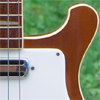
I recently found a 1987 MapleGlo 4001v63. It looked a little too flawless. As I examined closer, I noticed some small red areas, under the finish, that were on the fretboard, nut and frets. It looked almost like a polishing compound or filler that wasn't quite wiped off. The finish was very glossy but had an appearance similar to that of an acoustic guitar, in the way that you can see that the laquer follows the grain. Most of the RICs I have seen, including my 1976 4001, appear thicker and very glassy. The finish also covered the side of the bone nut.
The questions are: does this sound like a refinish and what would it be worth?
Identifying a Refinish
Moderator: jingle_jangle
the best way to tell is with a magnifying glass(es) and look in the walls of the routes .
If it was colored before you will find this colorant in the end grain of the walls .If the guitar was natural /mapleglo ...this is harder to tell .
If it was resprayed in Nitro Cell.Lacquer ,a simple solvent test in a cavity will give you the answer.
If the guitar has a polyester or urethane finish these have specific looks and they build in the corners quickly ,leaving a large build up around the neck or edges of cavities.
The best place to look is the truss rod cavity.
Again ...look for color on the walls in the end grain.
Look at the edges of the binding on the body where there may have been a fill ....defects show up on even the best refinishes .They tell the tale .
A side note ....I know of many Gibson guitars that have always been natural /clear coated only and they show signs of red under the plastic parts.
I must assume that the pickup frames are heavily colored with red tints to create the black parts .Also metals react with paints to turn thing black so beware of those ,this is not just a trate of Gibson .
Red on the fretboard of a Rick is putty from wood chippage. You can hide defects under color, but not on the fretboard .
If it was colored before you will find this colorant in the end grain of the walls .If the guitar was natural /mapleglo ...this is harder to tell .
If it was resprayed in Nitro Cell.Lacquer ,a simple solvent test in a cavity will give you the answer.
If the guitar has a polyester or urethane finish these have specific looks and they build in the corners quickly ,leaving a large build up around the neck or edges of cavities.
The best place to look is the truss rod cavity.
Again ...look for color on the walls in the end grain.
Look at the edges of the binding on the body where there may have been a fill ....defects show up on even the best refinishes .They tell the tale .
A side note ....I know of many Gibson guitars that have always been natural /clear coated only and they show signs of red under the plastic parts.
I must assume that the pickup frames are heavily colored with red tints to create the black parts .Also metals react with paints to turn thing black so beware of those ,this is not just a trate of Gibson .
Red on the fretboard of a Rick is putty from wood chippage. You can hide defects under color, but not on the fretboard .
So you too want yours "ALAPWOB"?!?!
Thanks for the info. I took another look at it. Maybe the factory was a little sloppy on that day and forgot to wipe the excess putty from the fretboard, because it covered one or two of the fret ends and a bit was on the nut edge. Being an unbound model it is tough to hide a few chips on the edges. Knowing the high standards that RICs have, it makes me suspicious.
I did re-examine the finish and it looks pretty good. (no signs of what you describe, but I didn't remove the truss rod cover yet.)
If it was refinished, what should I expect to pay?
I did re-examine the finish and it looks pretty good. (no signs of what you describe, but I didn't remove the truss rod cover yet.)
If it was refinished, what should I expect to pay?
the putty you found is not putty ,but paste wood filler .Thisis a binder and silica .When the solvent evaporates the silica is left behind .With age the silica shows as whitish material in the pours.When new it is clearish and looks like the wood.
What you found was something that was next to impossible to detect when done at the factory.
Everyone....NOTE! I DO NOT KNOW WHAT A RICK IS WORTH!!!! I don't do that .
If you need to know that do it under appraisals.
What you found was something that was next to impossible to detect when done at the factory.
Everyone....NOTE! I DO NOT KNOW WHAT A RICK IS WORTH!!!! I don't do that .
If you need to know that do it under appraisals.
So you too want yours "ALAPWOB"?!?!