

Here's a dumb question, but one I've been thinking about, since my only real experience with Ricks is my 335 with vintage pickups. What defines, or causes, a Rick to sound like a Rick? I know that my pickups sound a bit jangly, but apparently so do high gains or humbuckers, but to a different extent (I am referring more to 300 or 600 series). And if pickups alone don't make the biggest difference as to a guitar sounding like a Rick (ie, putting the same pickups on a crummy guitar wouldn't make it sound like a Rick.), then what does?
So my question is this: Given the total package that makes a Rickenbacker sound like it does, what rank order would you give to the importance of individual components of a given Rickenbacker guitar to the creation of "the sound"?
Defining the Rickenbacker Sound
Moderators: rickenbrother, ajish4

Thank you Mr. Hall! One follow up question -- does item #1 hold true for all Rickenbackers regardless of whether or not the neck goes all the way through the guitar? Or is there a big variation for those that are not? If all necks go through then I am just sounding stupid. I will trust your answer, of course!
Also the fact of the tonal color that Maple gives.
One of the earliest examples of the part played by
just the wood alone, came back in the early 70s, when a bassist friend of mine had to replace the original tungsten steel horseshoe PU in his '63 4000 bass.In '71, there was not the open availability of guitar parts like there is now, and a lot of guys who needed a quick fix bought
whatever seemed like it could work. In this case, my buddy got a Fender Jazz Bass PU, and jury rigged it to fit the 4000 PU cavity.I had heard the bass before the new PU was added, and, well, it sounded[duh!] like a good Rick bass.To my surprise, it Still retained a Ricky edge to it, even without the old horseshoe.Based on this experience, I had to conclude that the all maple structure alone contributed a very large percentage of the sound.
One of the earliest examples of the part played by
just the wood alone, came back in the early 70s, when a bassist friend of mine had to replace the original tungsten steel horseshoe PU in his '63 4000 bass.In '71, there was not the open availability of guitar parts like there is now, and a lot of guys who needed a quick fix bought
whatever seemed like it could work. In this case, my buddy got a Fender Jazz Bass PU, and jury rigged it to fit the 4000 PU cavity.I had heard the bass before the new PU was added, and, well, it sounded[duh!] like a good Rick bass.To my surprise, it Still retained a Ricky edge to it, even without the old horseshoe.Based on this experience, I had to conclude that the all maple structure alone contributed a very large percentage of the sound.
-
axel
Very interesting thread,
my 360 has two HB1s, 620 has regular HiGains - plugged in the same preamp (Boogie Quad), same settings, same pots postions one could almost swear it's the same guitar. 360 is now louder obviously but the tone, the texture of it, remains the same, whether clean channel or crunch.
So if one had a more angled headstock, would it sound..."darker" ?
And the tailpiece, R or trapeze: would anyone having switched care to describe the changes in sustain or brightness or...?
my 360 has two HB1s, 620 has regular HiGains - plugged in the same preamp (Boogie Quad), same settings, same pots postions one could almost swear it's the same guitar. 360 is now louder obviously but the tone, the texture of it, remains the same, whether clean channel or crunch.
So if one had a more angled headstock, would it sound..."darker" ?
And the tailpiece, R or trapeze: would anyone having switched care to describe the changes in sustain or brightness or...?
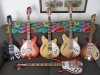
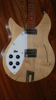
Interesting comments...when plugged in, my new 360/12CW has a very similar tone to my 1968 370/12...the 370 may be a little thinner in tone but they are just as bright. The 360/12CW when unplugged is a much louder guitar with a boomier, more acoustic sound, possibly due to the lack of additional hardware (a third p'up)....but I agree with John Hall about the other construction aspects---I am a big fan of the old 6-saddle bridge and aluminum saddles especially. Yes Virginia, they DO still make then like they used to!!!
-
jazzsmith



John: This little riff at rickresource.com is played on a 1966 450/12 using RIC strings through a boss chorus pedal straight into a fostex recorder.
Life, as with music, often requires one to let go of the melody and listen to the rhythm
Please join the Official RickResource Forum Facebook Page https://www.facebook.com/groups/379271585440277
Please join the Official RickResource Forum Facebook Page https://www.facebook.com/groups/379271585440277

Mr. Hall, you mentioned "neck to body" joint as a defining factor of "the sound". Does this hold true for the model 480, given that it is a bolt on neck? I have never heard one played. If this does not hold true for the 480, I am curious to hear a description of the general difference in sound between a 480 and, say, a 300 series guitar. Thanks!