
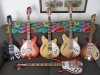
In the "Rickenbacker Book" by Bacon and Day...the is a Model 460 from 1961 in Fireglo, with gold guards and nameplate and small black knobs. A nice guitar by anyones' measure...
What is uncommon about it is that it has crushed-pearl inlay on the fretboard, which I thought was not used until late 1963-early 1964. The Klusons also look like a later style, w/out the hex nuts showing on the front side of the headstock. This is the only Rickenbacker I can think of that is pre-Beatlemania with crushed-pearl inlay...Does anyone else have any observations on this, and could it be something other than a '61????
1961 Rickenbacker 460- or is it???
Moderators: rickenbrother, ajish4
I've always been suspicious of this one too.
It appears to be a renecked 460 with a replaced guard. It could just be re-fingerboarded, since a reneck would basically total a neck-through guitar.
I don't have the book in front of me, but I believe it has the '61 type adjustable bridge (with the big square truss cover), but the crushed pearl inlays as you mentioned. The guard is also gold backed plastic, rather than anodized metal as in the description. It's still a cool old Ric.
Now try listing the inaccuracies of the Rickenbacker descriptions in the Gruhn and Carter "Electric Guitars and Basses" book. I don't even think they got 50% of them right.
It appears to be a renecked 460 with a replaced guard. It could just be re-fingerboarded, since a reneck would basically total a neck-through guitar.
I don't have the book in front of me, but I believe it has the '61 type adjustable bridge (with the big square truss cover), but the crushed pearl inlays as you mentioned. The guard is also gold backed plastic, rather than anodized metal as in the description. It's still a cool old Ric.
Now try listing the inaccuracies of the Rickenbacker descriptions in the Gruhn and Carter "Electric Guitars and Basses" book. I don't even think they got 50% of them right.
Tony: There is yet one more chapter on this instrument:
I was reading in the glossary of this book last night in the photo credit section....according to the book this guitar was stolen not long after the photo was taken for the book. The serial # dates it to 1961, but I am in agreement with you all the way. Too many things just do not seem right for the guitar to be 100% correct.
I was reading in the glossary of this book last night in the photo credit section....according to the book this guitar was stolen not long after the photo was taken for the book. The serial # dates it to 1961, but I am in agreement with you all the way. Too many things just do not seem right for the guitar to be 100% correct.
-
squirebass
- Veteran RRF member
- Posts: 1581
- Joined: Fri Oct 13, 2000 11:05 pm
I'd like someone to clear up the issue of "crushed Pearl inlays" vs the edge to edge inlays that appear to me to be mother of pearl or some other material. I have seen a LOT of vintage Ricks and it looks like they used both materials virtually side by side on 60s Ricks. I have seen a '64 365 at a guitar show that did NOT have the "crushed pearl" inlays but it had the edge to edge stuff that looks like that stuff that you put in a parakeets cage so it can sharpen its beak (Sorry I couldn't think of any better example!). The crushed pearl looks sparkley and the other material has a more chalky look. I believe that George Harrison's 360/12OS(the one he got in NY in '64) had the chalky kind of inlays, not crushed pearl. Maybe Mark A., John Williams, or Mr. Hall could provide some clarification here?
"This is the big one, Elizabeth, I'm coming to join ya, honey!"
Gene: Basically, the 'edge-to-edge' triangle inlays that started appearing on Rickenbacker deluxe models circa 1957-58 were a solid one-piece material that varied in composition from time to time until the very end of 1963-Jan. 1964 when a new source of material was used on the fretboard inlays. This is the 'crushed pearl' (the material was crushed and then set in a clear resin) that you see on Roger McGuinn's original Byrd's Rickenbacker 12-strings and most Rickenbacker deluxe models until about 1969 when a solid one-piece material resembling linoleum was used from time to time until 1973, when the current method of round-edge inlays was implemented. The 'linoleum' inlays have the chalky look you speak of. This is the way I understand it, and there are other threads on the Forum that discuss this in detail. Good Luck!!
-
squirebass
- Veteran RRF member
- Posts: 1581
- Joined: Fri Oct 13, 2000 11:05 pm
Yeah, I know about the edge-to-edge inlays, but what I would like to know is why the chalky inlays and the sparkley crushed pearl inlays seemed to appear almost side by side in production in the 60s. Like the Grover's vs Kluson tuners in the early 70's. I have seen examples of this again and again. I've seen '64, and later basses that had the chalky material, and other basses from the same general period that had the crushed pearl stuff on them. I refer to basses because that is what I'm more interested in and know better, but I've also seen examples of it in guitars as well. I saw two early seventies Rick basses at the Dallas Guitar Show recently, both with checker binding and edge to edge inlays. One was crushed pearl(a 1972), the other one was the chalky stuff(1971). I remember reading a thread from John Hall either here or on the alt.guitar.rickenbacker page where he said that the crushed pearl was done by a Japanese company that is now out of business, and that they tried to duplicate it or have other companies duplicate it and failed miserably.. Maybe they were having difficulty getting the crushed pearl stuff made, so they ocassionally had to go to the chalky stuff, like what happened with the Grovers vs the Klusons...
"This is the big one, Elizabeth, I'm coming to join ya, honey!"
I think you may find more of the earlier inlay material on the basses further into the sixties because they weren't big sellers- so they may have been finishing up models that had been sitting around for a while.
I don't think I've seen any deluxe Ric guitars from '64 - '72 that don't have the crushed-pearl inlays.
The basses changed their inlay material in '73 from crushed pearl to a full-width creamier type, then to the partial width- but I haven't seen any guitars with the transitional full-width creamy inlays (though '73 Ric guitars are extremely hard to come by). The '71 Ric you saw without crushed inlays sounds pretty strange to me.
I don't think I've seen any deluxe Ric guitars from '64 - '72 that don't have the crushed-pearl inlays.
The basses changed their inlay material in '73 from crushed pearl to a full-width creamier type, then to the partial width- but I haven't seen any guitars with the transitional full-width creamy inlays (though '73 Ric guitars are extremely hard to come by). The '71 Ric you saw without crushed inlays sounds pretty strange to me.
-
squirebass
- Veteran RRF member
- Posts: 1581
- Joined: Fri Oct 13, 2000 11:05 pm
I've seen a '64 360/12 that had the chalky inlays. It was at a guitar show a couple of years ago. I've also seen at couple of '68 basses that had this type of inlay. At a guitar show last year, I saw the '64 Rick 4001 that is pictured in the front of "The Bass Book" by Bacon and Day(first couple of pages). It had beautiful crushed pearl inlays and I would've bought it if I'd had $6,000 in my wallet at the time!
"This is the big one, Elizabeth, I'm coming to join ya, honey!"
My 1972 4001LH has crushed-pearl inlay/check binding/toaster neck p'up..there was a '73 4001 in Mapleglo on ebay recently that had the solid "chalky" inlays. It's probably just what they had on the shelf the day they were made...
I think it was a case of whatever they had in stock at the time to build with, or could obtain...I am thinking of the same thread you are concerning the sporadic use and eventual discontinuation of the crushed-pearl style edge-to-edge inlays---the supplier went belly-up. I have seen basses as early as 1968 with the solid chalky edge-to-edge style. The 1963 4001 in Richard Smith's book has the same style inlays as George Harrison's 1963 360/12 and Mike Campbell's 1963 625/12--not quite the chalk variety but solid...those may be the 'linoleum' inlays everyone speaks of...I think John Hall has said for the 360/12C63 they have a match for the material used for the orig. and the C-Series re-creation...the very first 360/12 made had inlays similar in composition to what you would find on prototype and production Rickenbackers from the late '50's, more of a fancy pearloid-look. I agree with you---there were no absolutes when building these instruments and certainly there will be things that show up that are out of the ordinary. That's what makes it neat!!!
I think it was a case of whatever they had in stock at the time to build with, or could obtain...I am thinking of the same thread you are concerning the sporadic use and eventual discontinuation of the crushed-pearl style edge-to-edge inlays---the supplier went belly-up. I have seen basses as early as 1968 with the solid chalky edge-to-edge style. The 1963 4001 in Richard Smith's book has the same style inlays as George Harrison's 1963 360/12 and Mike Campbell's 1963 625/12--not quite the chalk variety but solid...those may be the 'linoleum' inlays everyone speaks of...I think John Hall has said for the 360/12C63 they have a match for the material used for the orig. and the C-Series re-creation...the very first 360/12 made had inlays similar in composition to what you would find on prototype and production Rickenbackers from the late '50's, more of a fancy pearloid-look. I agree with you---there were no absolutes when building these instruments and certainly there will be things that show up that are out of the ordinary. That's what makes it neat!!!
-
squirebass
- Veteran RRF member
- Posts: 1581
- Joined: Fri Oct 13, 2000 11:05 pm
If only we could get ALL the Rickenbacker's together under one roof, in a place like the Astrodome or something!!! I'd be willing to spend a lot of time going thru them!!!
I currently have a 660/12BG on order, and they all have that "linoleum" stuff for inlays, but I would love to get hold of a '60s or early '70s Rick bass, but each time I see one, I either don't have the money or they want too much for it!
I once saw a 1972 BG 4001 on ebay that was sweet! Looked to be in excellent condition and in one of my favorite Rick finishes. I think John Casselman owns it now - at least I think I saw pics of it on this site...
John, How LONG did you have to wait to find a 1972 Lefty?? I'd like to see some pics of that one...
I currently have a 660/12BG on order, and they all have that "linoleum" stuff for inlays, but I would love to get hold of a '60s or early '70s Rick bass, but each time I see one, I either don't have the money or they want too much for it!
I once saw a 1972 BG 4001 on ebay that was sweet! Looked to be in excellent condition and in one of my favorite Rick finishes. I think John Casselman owns it now - at least I think I saw pics of it on this site...
John, How LONG did you have to wait to find a 1972 Lefty?? I'd like to see some pics of that one...
"This is the big one, Elizabeth, I'm coming to join ya, honey!"
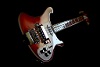
Gene - It's a righty, sorry. It is Burgundyglo and it does have the toaster pickup, checkered binding, full edge to edge crushed pearl inlays, split tailpiece, and Grovers.
I did drop a horseshoe pickup into it, but not the pickup surround. I left the original on it and sold the large surround that came with the horseshoe pu. The pickup and surround on my bass look just like the one on the new 4001C64S.
I just found the original bridge pickup output was to low even after I bypassed the .0047 cap. She really puts out now!
But to answer your question, I searched high and low for about 10 years for my bass. I could have had the same bass sooner in this finish, but the 2 basses that I found were beat and the asking price was excessive. I knew exactly what I wanted and wouldn't settle for anything other than the dark Burgundyglo with the above features.
I couldn't imagine how long it would take to find a left handed version of the same bass. I can't remember ever having seen one.
Perhaps Don or Mark might be able to comment on if they can remember seeing any 4001's built as left handed models in Burgundyglo in the early 70's.
Cheers,
Jon
I did drop a horseshoe pickup into it, but not the pickup surround. I left the original on it and sold the large surround that came with the horseshoe pu. The pickup and surround on my bass look just like the one on the new 4001C64S.
I just found the original bridge pickup output was to low even after I bypassed the .0047 cap. She really puts out now!
But to answer your question, I searched high and low for about 10 years for my bass. I could have had the same bass sooner in this finish, but the 2 basses that I found were beat and the asking price was excessive. I knew exactly what I wanted and wouldn't settle for anything other than the dark Burgundyglo with the above features.
I couldn't imagine how long it would take to find a left handed version of the same bass. I can't remember ever having seen one.
Perhaps Don or Mark might be able to comment on if they can remember seeing any 4001's built as left handed models in Burgundyglo in the early 70's.
Cheers,
Jon
"Perhaps Don or Mark might be able to comment on if they can remember seeing any 4001's built as left handed models in Burgundyglo in the early 70's. "
Wow, you're trying to jumpstart my brain on That detail!I was only there for 4 months ,summer '72,
and I won't say that there were not any lefties mfd., but assuming there were, I'd bet they were Vey Few. As to the color issue; I never knew What happened paint-wise after it left the bldg. I was in/the woodshop proper: Mark??
Wow, you're trying to jumpstart my brain on That detail!I was only there for 4 months ,summer '72,
and I won't say that there were not any lefties mfd., but assuming there were, I'd bet they were Vey Few. As to the color issue; I never knew What happened paint-wise after it left the bldg. I was in/the woodshop proper: Mark??
-
squirebass
- Veteran RRF member
- Posts: 1581
- Joined: Fri Oct 13, 2000 11:05 pm
 ) When I first saw the pic I thought it was Jetglo, but then those old Burgandy finishes do almost look black. Very nice bass, would you like to sell it?
The thought of selling it has crossed my mind a few times, but only because it has been religated to being my back up bass. I now only play my StingRay-5 that I bought a year ago. So my 4001 now hangs on my wall with a number of my other basses.
It does appear to be Jetglo until you get within 5-6 feet of it. I just love this colour, it's always been my favourite RIC finish. I'm glad to see it being reissued as the special colour of the year.
The only way that I would sell this bass Gene is if John Hall would either open a custom shop (and we all know that will never happen) or if he will produce what I call a 4001C69 that's available in burgundyglo and I know that will never happen either. So until then she's not for sale, sorry.
Believe me, i've been asking him for this for the past 5 years. Unfortunately, it was decided that the market needed the 4001C64 & C64S much worse than I (and others) needed a 4001C69.
Cheers
Jon
PS - If you think my bass looks very cool, you should play it. Absolutely amazing! I do have a few more pics of it that I can send you if you want. Just let me know.
It does appear to be Jetglo until you get within 5-6 feet of it. I just love this colour, it's always been my favourite RIC finish. I'm glad to see it being reissued as the special colour of the year.
The only way that I would sell this bass Gene is if John Hall would either open a custom shop (and we all know that will never happen) or if he will produce what I call a 4001C69 that's available in burgundyglo and I know that will never happen either. So until then she's not for sale, sorry.
Believe me, i've been asking him for this for the past 5 years. Unfortunately, it was decided that the market needed the 4001C64 & C64S much worse than I (and others) needed a 4001C69.
Cheers
Jon
PS - If you think my bass looks very cool, you should play it. Absolutely amazing! I do have a few more pics of it that I can send you if you want. Just let me know.