
Crushed MOP inlays
Moderators: rickenbrother, ajish4
Crushed MOP inlays
When did Rickenbacker transition from the full width milky white inlays to the crushed MOP type? I am guessing it was '63 or '64.
That certainly fits with what I have noticed, John. All of the '64 deluxe Ricks I have seen have MOP. The '63 4001 in the Smith book has the milky ones as does my '63. I was wondering if the change occured abruptly from one year to the next of if it happened gradually, like most Rickenbacker transitions.
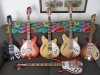
Ted, the crushed pearl (CP) inlay was actually around at least as early as 1957, you can see it sporadically used on some early Capri prototypes.. it's quite clear in the pics.
There were at least three, maybe four styles of material that were used for the deluxe inlay, and again the majority of these were solid pieces. The last style observed before the wide use of CP inlay began in early 1964 was what I like to call 'linoleum' inlay, very gray in color and nearly non-reflective. Here are two guitars with this typ of inlay, made in 1963:
http://www.homestead.com/aurs/dm625460.html
George Harrison's '63 360/12 had this type of inlay and has a Dec. 1963 sn#. Gerry Marsden's March 1964 360/12 was identical to George's, except it had CP inlay.
There were at least three, maybe four styles of material that were used for the deluxe inlay, and again the majority of these were solid pieces. The last style observed before the wide use of CP inlay began in early 1964 was what I like to call 'linoleum' inlay, very gray in color and nearly non-reflective. Here are two guitars with this typ of inlay, made in 1963:
http://www.homestead.com/aurs/dm625460.html
George Harrison's '63 360/12 had this type of inlay and has a Dec. 1963 sn#. Gerry Marsden's March 1964 360/12 was identical to George's, except it had CP inlay.
-
jingle_jangle
- RRF Moderator
- Posts: 22679
- Joined: Wed Dec 22, 2004 6:00 am
- Contact:
These "swirly" inlays are transparent polyester resin with white pearl essence powder mixed in. They are cast-in place. The resin is mixed up with catalyst and the pearl powder and dribbled into the triangular recessed which have been cut or routed into the fretboard. The recesses are overfilled and when hardened, the entire fretboard is radiused.
There are some good photos of this process in Dale's pictorial on "Building a Solid Body Guitar" from a few months back.
BTW, I've located a material that, at least in photos, looks a lot like the sparkly crushed stuff. John Hall says it's not the same stuff, but I've ordered a bit to see how close it actually is.

There are some good photos of this process in Dale's pictorial on "Building a Solid Body Guitar" from a few months back.
BTW, I've located a material that, at least in photos, looks a lot like the sparkly crushed stuff. John Hall says it's not the same stuff, but I've ordered a bit to see how close it actually is.
“I say in speeches that a plausible mission of artists is to make people appreciate being alive at least a little bit. I am then asked if I know of any artists who pulled that off. I reply, 'The Beatles did.”
― Kurt Vonnegut
― Kurt Vonnegut


-
jingle_jangle
- RRF Moderator
- Posts: 22679
- Joined: Wed Dec 22, 2004 6:00 am
- Contact:
-
dale_fortune
- Intermediate Member
- Posts: 1241
- Joined: Sat Oct 30, 2004 6:00 am
This is one of my favorite subjects since I worked there in the 73 transition period. The wide inlays that were resin/pearl toner base, were made in sheets starting with a thin layer of white resin. Over this was poured a layer of clear resin that was mixed with a pearl toner. These supplies came from Standard Brands Paint just down the street from Electro. After these had cured, they were cut on a table saw to the various widths and fitted into the finger boards that had the inlay pockets already cut full width on the pin router. This was a very time consuming procedure which led to the smaller tri-angel inlays and the pouring of these. They were done in this manner. The F.B. was routed for the tri-angel inlays, then glued to the neck stock, then to the inlay dept. where they were 1st painted grey as a base coat, then the pearl resin mixture was poured into the cavities with just a little overflowing. Let this cure, run neck stock thru the big belt sander, then to the crowning sander, then frets were installed, binding put on, neck shaped and sanded. Whew, seems like only yesterday. Now the body wings were glued on. I have posted some pictures of the inlay material that I still have from that era. There are several different types: the solid white vinyl of .060 that was cut and glued in the full width, circa early 60's, the real C.P. inlays which were also cut from 12X12inch sheets then glued in, circa 1964, then the last inlays of the transition period, late 60's thru mid 1973, these were a multi layer of white base coat and pearl toned resin poured over this, cut on a table saw and fitted to the finger boards.
http://photobucket.com/albums/b53/DaleFortune/000_0989.jpg
http://photobucket.com/albums/b53/DaleFortune/000_0990.jpg
http://photobucket.com/albums/b53/DaleFortune/000_0991.jpg
http://photobucket.com/albums/b53/DaleFortune/000_0992.jpg
http://photobucket.com/albums/b53/DaleFortune/000_0993.jpg
http://photobucket.com/albums/b53/DaleFortune/000_0744.jpg
http://photobucket.com/albums/b53/DaleFortune/000_0739.jpg
The last 2 photos show how I replicate the original C.P. inlays, yes those hand sanding blocks are 4001 neck stock. I made those at the factory in 1973, they have lasted a long long time, at least a million miles on them.
http://photobucket.com/albums/b53/DaleFortune/000_0989.jpg

http://photobucket.com/albums/b53/DaleFortune/000_0990.jpg

http://photobucket.com/albums/b53/DaleFortune/000_0991.jpg

http://photobucket.com/albums/b53/DaleFortune/000_0992.jpg

http://photobucket.com/albums/b53/DaleFortune/000_0993.jpg

http://photobucket.com/albums/b53/DaleFortune/000_0744.jpg

http://photobucket.com/albums/b53/DaleFortune/000_0739.jpg

The last 2 photos show how I replicate the original C.P. inlays, yes those hand sanding blocks are 4001 neck stock. I made those at the factory in 1973, they have lasted a long long time, at least a million miles on them.
-
dale_fortune
- Intermediate Member
- Posts: 1241
- Joined: Sat Oct 30, 2004 6:00 am
http://www.youtube.com/w/The-Beatles---Live-in-Australia-1964?v=SCg2sBL2jUM&search=beatles
This take a minute to upload, but it's soooooo good!
This take a minute to upload, but it's soooooo good!
Good one, Dale. Here's another video featuring Dusty Springfield and George's '62 425....
http://www.youtube.com/w/The-Beatles---Ready%2C-Steady%2C-Go-1963?v=_M-qHiPR9zI&search=beatles
http://www.youtube.com/w/The-Beatles---Ready%2C-Steady%2C-Go-1963?v=_M-qHiPR9zI&search=beatles
-
dale_fortune
- Intermediate Member
- Posts: 1241
- Joined: Sat Oct 30, 2004 6:00 am