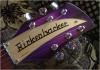
OK, back in the living here, after spending the day with "that" brand new guitar (which received an "F"-hole yesterday before it was ever played) and an '80s BT bass that's getting rebound with checkerboard and white.The answer to the first question (can an "F"-hole be cut in a guitar without hurting the finish?) is yes. It takes a good deal of care and is quite a fiddly job, but it can be done.
Case in point is a 350V63 with zero miles and a gorgeous factory FG finish, with dealer tags still on the headstock.
The first step is to figure out just what type of "F"-hole we are going for. There are at least two which were used on 1996s. Fellow Forumite Kevin Kuney kindly faxed me tracings of the two, taken from his own instruments. The so-called "two o'clock" one is quite different from the "one o'clock" one, and the owner (who can chime in anytime here if he doesn't mind; I didn't ask his permission to identify him) wanted a 350 with the Lennon touches to replicate John's 1996, so we went with the "one o'clock" "F"-hole and an Accent Vibrato to complete the look.
Only one problem--the hardware arrangement on the 1996 is different from that on the V63--the pickups are much closer together and the bridge is in a different place, so exactly replicating the same "F"-hole on a 350 would look strange, as it would place the hole in a too-far-forward position and far too close to the guitar's edge. So I redid the "F"-hole slightly to shorten it a bit and shift it back a tad, and the result is a look that replicates that of Lennon's guitar.
First step was to have a look at a '60s 1996; Babiuk's book is invaluable as it has a nice large view that I blew up to actual size. I then compared Kevin's tracing to the original and it was very close. I then took the enlarged hole pattern and fitted it to the guitar's top. It was at this point that it was determined that full-size wouldn't do, and it was shortened by 4.5mm to allow it to fit properly.

Next, the paper pattern was glued to a piece of 2mm thick T6 aluminum sheet, which was machined out in the area of the "F"-Hole.

The rather random mill marks were carefully cleaned up with jewelers' files until absolutely smooth, and this aluminum piece was deburred to become the template for routing the "F"-hole.

The template was taped into place on the guitar's top and then the hole was carefully routed using a 1/8" diameter pilot shank bit. The resulting hole after the template was peeled off looks like this:

You can see the shavings in the guitar. The edges were a bit rough, so they were filled, sanded smooth, and painted black. Then the edges of the hole were carefully sanded to round them off (but only a few thou', the thickness of the conversion varnish), and the whole area was hand-buffed and detailed. The guitar was blown off, vacuumed out and it's ready to ship to its owner.
“I say in speeches that a plausible mission of artists is to make people appreciate being alive at least a little bit. I am then asked if I know of any artists who pulled that off. I reply, 'The Beatles did.”
― Kurt Vonnegut