
Hmmm the more I learn - the more I need to know. Good thing I'm almost 50 - funny though when I was 20 I thought I knew everything there was to know. Oh well.
I really require some education on 320's. I thought that all US sold Rics were made with the slash style sound holes and only the models exported to the UK ie Rose Morris had the "F" style sound hole? Am I correct or some of the early US models produced with the "F" style soundhole.
I have another question on 320's are they all short scale guitars?
Lastly would I be right in assuming a late 70's -320 in 7 out of 10 condition would be worth around $800?
Thanks for any and all replies.
320 Clarification
Moderators: rickenbrother, ajish4
-
sloop_john_b

- Rick-a-holic
- Posts: 13843
- Joined: Tue Jan 25, 2005 6:00 am
-
jingle_jangle

- RRF Moderator
- Posts: 22679
- Joined: Wed Dec 22, 2004 6:00 am
- Contact:
In general, 320s had no sound holes, unless they were export RMs, in which case they were called 1996s and had "F" holes. Somebody out there is gonna have a slash-holed 320 or 325 or 310, so I have to say, "in general".
All were shorties, with a 20.75" scale. This is SHORT short.
You're probably not far off in valuation, depending upon eye appeal, color, wear, etc. "7 out of 10" is not enough information and is pretty subjective in itself.
All were shorties, with a 20.75" scale. This is SHORT short.
You're probably not far off in valuation, depending upon eye appeal, color, wear, etc. "7 out of 10" is not enough information and is pretty subjective in itself.
“I say in speeches that a plausible mission of artists is to make people appreciate being alive at least a little bit. I am then asked if I know of any artists who pulled that off. I reply, 'The Beatles did.”
― Kurt Vonnegut
― Kurt Vonnegut
-
sloop_john_b
- Rick-a-holic
- Posts: 13843
- Joined: Tue Jan 25, 2005 6:00 am
-
jingle_jangle
- RRF Moderator
- Posts: 22679
- Joined: Wed Dec 22, 2004 6:00 am
- Contact:
"7 of 10" is a scale of physical condition, not rarity or color. If you've got a late '70s 320 with an "F" hole, that's beyond my expertise. Is Dr. Belloff in the house?
“I say in speeches that a plausible mission of artists is to make people appreciate being alive at least a little bit. I am then asked if I know of any artists who pulled that off. I reply, 'The Beatles did.”
― Kurt Vonnegut
― Kurt Vonnegut



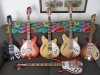
F-holes were standard on the short-scale Capris until around the late 70's when the solid-top became standard, which was reaction to the demand for a Beatle-looking 320-325. Rose-Morris instruments almost always had an 'f' sound-hole.
Most of the domestic 3/4-scale 310-325 guitars you see from the 60s and 70s have the f-hole like Gary's MG 320 pictured above.
Solid-top 325s from the 60s are quite rare despite the fact that Lennon played one...more were made with f-holes.
Most of the domestic 3/4-scale 310-325 guitars you see from the 60s and 70s have the f-hole like Gary's MG 320 pictured above.
Solid-top 325s from the 60s are quite rare despite the fact that Lennon played one...more were made with f-holes.
Len, catagorically, yes. My post is based soley upon what I've held and seen through the years, so your mileage may vary...
A fine cross-section of these guitars can be found on Glen Lambert's site, the 325 Connection:
http://www.geocities.com/vintage325/
The Rose-Morris export model 1996 had the f-hole as a requested specification as did all hollow-body export models, but it was also possible to obtain certain models in the US with the same specs, but the model number was different; Carl Wilson had a model 330s/12, which was identical to the RM1993. McCartney's own Rickenbacker bass, the 4001-S, was identical to the RM1999.
Ultimately it may only be possible to prove a Rose-Morris pedigree with data from the shipping docs at Rickenbacker, for instruments with identical specs were sold on either side of the Atlantic.
A fine cross-section of these guitars can be found on Glen Lambert's site, the 325 Connection:
http://www.geocities.com/vintage325/
The Rose-Morris export model 1996 had the f-hole as a requested specification as did all hollow-body export models, but it was also possible to obtain certain models in the US with the same specs, but the model number was different; Carl Wilson had a model 330s/12, which was identical to the RM1993. McCartney's own Rickenbacker bass, the 4001-S, was identical to the RM1999.
Ultimately it may only be possible to prove a Rose-Morris pedigree with data from the shipping docs at Rickenbacker, for instruments with identical specs were sold on either side of the Atlantic.
-
rickinroma

- RRF Consultant
- Posts: 1111
- Joined: Tue Oct 19, 2004 11:27 pm
- Contact:

-
jingle_jangle
- RRF Moderator
- Posts: 22679
- Joined: Wed Dec 22, 2004 6:00 am
- Contact:
Thanks for the detailed clarification, John. This is one of a number of issues that sometimes confuse those of us who are RIC newbies.
I have a customer with a MG '66 that is visually identical to the one you show, Gary. I thought it was a RM...
I have a customer with a MG '66 that is visually identical to the one you show, Gary. I thought it was a RM...
“I say in speeches that a plausible mission of artists is to make people appreciate being alive at least a little bit. I am then asked if I know of any artists who pulled that off. I reply, 'The Beatles did.”
― Kurt Vonnegut
― Kurt Vonnegut
Thanks to everyone on this thread as I definitely know more about this issue than I did when I started. But I must admit I liked it better when I thought "f" style sound holes were only produced for export models.
John mentioned that perhaps the only sure way to tell the difference between domestic and export models with similar "f" holes would be to examine the shipping records. How easy is it to access these records?
If you are trying to date the age of a 1960's Ric that has no serial number can this be done by date coding the pots? or are there other tell tale signs.
Lastly in the 60's did Ric use deArmond/centralab volume and tone pots?
John mentioned that perhaps the only sure way to tell the difference between domestic and export models with similar "f" holes would be to examine the shipping records. How easy is it to access these records?
If you are trying to date the age of a 1960's Ric that has no serial number can this be done by date coding the pots? or are there other tell tale signs.
Lastly in the 60's did Ric use deArmond/centralab volume and tone pots?