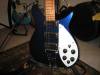
Hi everyone - I've been reading the forum messages for many weeks now and have just purchased a new 325C58 JG with a view to 'Lennonising' it. I'm new and this is my first post!
The many posts regarding fitting a B5 Bigsy have been really interesting, but my own problem is that the Bigsby doesn't fit FLAT on the Ric - it has about a 1/4" gap at the pickup end when it's resting on the tail.
The picture below shows the 'lift' I have and I just wondered if anyone had come across this before and how they might have fixed it? I've seen a number of pictures of 325C58's with what seems to be B5's fitted fine?
Any thoughts would be very much appreciated - please help!
Posted this reply over in the C series section, but it appears the action is over here....
There was a thread a while back on this. Some of the comments, IIRC, focused on differences between the current reissue Bigsbys--the US models being a bit larger than the Selmer editions. I can't recall if they said you can still get the Selmer or not.
I have two 325s with Bigsbys, both the same (US) Bigsby. My JG it fits perfectly flush, my MG is not quite flush on the lower forward mount, though it's not anywhere near a 1/4". You can notice the black washer, whereas on the JG it's perfectly flat.
Not sure if it's a variance in the guitar or the Bigsby. Doesn't affect the play at all, and the unit is nice and tight.
I believe Paul has discussed regrinding the taper of the Bigsby to fit the 350V63's ramp but I hadn't heard of a 325 needing that done. Maybe he'll post on the subject when he's back online
I also put a US B5 on my 325C58 2 years ago, and did not have the gap showing in your example, Mixey. (The psychic scares from drilling holes in a brand-new Rickenbacker have not faded quite yet.)
This is a top-down view of mine. That leading screw under the vibrato handle does just peek over the crest of the tail but screwed down tight it looks and works just fine.
I've done B5s and B50s (Korean version with smaller bearing surfaces) on 350s, 330s, 320s, and 325s. In every case, I've removed the screw boss with a band saw (hack saw works fine, too--it's soft cast aluminum), filed smooth, sanded, and polished on a buffing wheel.
All these guitars have different "ramp" areas, and there are also variations from year to year and sometimes from guitar to guitar, due to the final sanding on these being done by hand.
Because of the angle of the "ramp" area with relation to the top, a small amount removed from the ramp can mean quite a difference in where the top of the ramp ("breakover point") occurs. However, this difference never exceeds 3/16", and you'd need twice that to accommodate the boss for that screw on a smaller body.
On the larger bodies, as I recall there was room for the boss, but I removed it anyway for the sake of appearance (in each case, historical accuracy was not an issue).
When the boss is removed, I relocate the screw hole to the center of the spring pad. I use the same screw, and countersink the hole in the pad so the screw sits and looks right.
I have heard that the Selmer units were 7% smaller. The possibly lucky combination of JL's particular 325 (which may have had a larger-than-usual ramp area) and the smaller old Selmer B5, worked out just right for him, but has tormented others since.
“I say in speeches that a plausible mission of artists is to make people appreciate being alive at least a little bit. I am then asked if I know of any artists who pulled that off. I reply, 'The Beatles did.”
― Kurt Vonnegut