
I've been playing at the same venue (1-2 shows a week) for over a year now and have never gotten a single microphone shock until three shows ago. Two out of the last three shows i've been getting real nasty ones.
The only thing that I can think of that's been different has been that for the last three shows, i've been using the v63 I recently picked up.
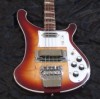
Out of curiousity, I popped the pickguard and found that there was a whole lotta shielding inside - have a look:
If this was improperly done, could it potentially be the cause of the shocks lately? Is there anything else inside that stands out to anyone else?
4001v63 - source of microphone shocks?
Moderator: jingle_jangle
-
sloop_john_b

- Rick-a-holic
- Posts: 13843
- Joined: Tue Jan 25, 2005 6:00 am
-
sloop_john_b
- Rick-a-holic
- Posts: 13843
- Joined: Tue Jan 25, 2005 6:00 am

Re: 4001v63 - source of microphone shocks?
John, if the wiring on anything isn't properly shielded you should also be picking up some unwanted noise, buzzing, hiss. Pretty noticeable stuff. It's like bad grounding almost. I can't say if it would contribute to shock though.
Re: 4001v63 - source of microphone shocks?
I don't think the shielding would contribute to your shocking situation.
If the PA system and your bass amp were plugged into the same phase leg of the electrical service, you should not get shocked anymore. To do this simply plug your bass amp into the same receptacle as the PA, if you can.
If the PA system and your bass amp were plugged into the same phase leg of the electrical service, you should not get shocked anymore. To do this simply plug your bass amp into the same receptacle as the PA, if you can.
-
rickenbrother

- RRF Moderator
- Posts: 13236
- Joined: Sun May 26, 2002 5:00 am
Re: 4001v63 - source of microphone shocks?
John, if your bass is going into the PA from your amp using a balanced cable, you can ground lift your amp. Then you will be on the same ground as the PA. You can do that if your amp has a balanced out jack and it's AC wire doesn't reach where the PA is plugged into.
JETGLO should officially be renamed JETGLO ROCKS! 

Re: 4001v63 - source of microphone shocks?
Also if the wiring at the outlets changed - ground opened - you could get shocked. Everyone who uses electricity on stage should have one of these in the gig bag:
http://www.homedepot.com/webapp/wcs/sto ... 401+502726
It will tell you if the outlet is properly wired.
http://www.homedepot.com/webapp/wcs/sto ... 401+502726
It will tell you if the outlet is properly wired.
-
leftyguitars

- Advanced Member
- Posts: 2818
- Joined: Sun Feb 20, 2005 1:44 am
- Contact:
Re: 4001v63 - source of microphone shocks?
This is potentially dangerous stuff.
Firstly, is the 'shock' a quick zap or continuous? A quick zap could be just static (from a nylon carpet for example).
If the 'shock' is continuous than you have a possible life threatening situation. Whatever you do don't lift any earths/grounds in your amp or any other equipment! If you do and there is a wiring fault in your amp or (more likely) the venue the only route to ground is through your body.
The classic electrocution situation on stage is - earth/ground has been lifted on amp (usually to remove an annoying buzz), and a faulty earth/ground in the venues electrical installation (more common than you would expect), guitarist mutes guitar strings with one hand, gets hold of mic stand with other hand, circuit is completed up one arm through the heart and down the other arm, the result - one dead guitarist.
Do you still get a shock if you are not holding the guitar?
Have you the same shoes on as before you got shocks? (Trainers especially can often charge up with static).
One test that I do (which works) is to hold the guitar by a non metal part and touch the strings against the mic stand. Is there a spark? Don't move your feet (static), now does it only spark the first time that you touch them together? Does it spark if you touch them together two seconds later?
Always use an RCD and always test it everytime you use it to prove that the earth/ground is correctly connected.
Firstly, is the 'shock' a quick zap or continuous? A quick zap could be just static (from a nylon carpet for example).
If the 'shock' is continuous than you have a possible life threatening situation. Whatever you do don't lift any earths/grounds in your amp or any other equipment! If you do and there is a wiring fault in your amp or (more likely) the venue the only route to ground is through your body.
The classic electrocution situation on stage is - earth/ground has been lifted on amp (usually to remove an annoying buzz), and a faulty earth/ground in the venues electrical installation (more common than you would expect), guitarist mutes guitar strings with one hand, gets hold of mic stand with other hand, circuit is completed up one arm through the heart and down the other arm, the result - one dead guitarist.
Do you still get a shock if you are not holding the guitar?
Have you the same shoes on as before you got shocks? (Trainers especially can often charge up with static).
One test that I do (which works) is to hold the guitar by a non metal part and touch the strings against the mic stand. Is there a spark? Don't move your feet (static), now does it only spark the first time that you touch them together? Does it spark if you touch them together two seconds later?
Always use an RCD and always test it everytime you use it to prove that the earth/ground is correctly connected.
Re: 4001v63 - source of microphone shocks?
Peter, what is an RCD?
-
stevebasshead
- Member
- Posts: 233
- Joined: Mon Mar 12, 2007 4:34 am
Re: 4001v63 - source of microphone shocks?
John, RCD is Residual Current Device, seems to be UK terminology. From Wikipedia - "In the United States and Canada, a residual current device is also known as a ground fault circuit interrupter (GFCI), Ground Fault Interrupter (GFI) or an appliance leakage current interrupter (ALCI)."
Pretty essential considering some of the beat-up sockets I've seen in the pubs I've played
Pretty essential considering some of the beat-up sockets I've seen in the pubs I've played
-
leftyguitars
- Advanced Member
- Posts: 2818
- Joined: Sun Feb 20, 2005 1:44 am
- Contact:
Re: 4001v63 - source of microphone shocks?
Yes, that sounds like the US equivalent. The ones that we use measure the outgoing and return current and if there is a 30 milliamp or more difference (I.E. because of a leak to earth/ground) it will 'trip out' and disconnect the power instantly. They only work on 'Class 1' equipment (that is a three wire plug & cable), 'Class 2' equipment only has two wires (no earth/ground) and must be of a double insulated design and must carry a double insulated logo, which is a small square inside another small square, (UK standards).
I NEVER play a gig without using RCD's. I know of people who's lives have been saved because they used them, I also know of people who have died because they didn't use them in faulty wired venues.
I NEVER play a gig without using RCD's. I know of people who's lives have been saved because they used them, I also know of people who have died because they didn't use them in faulty wired venues.
-
leftyguitars
- Advanced Member
- Posts: 2818
- Joined: Sun Feb 20, 2005 1:44 am
- Contact:
Re: 4001v63 - source of microphone shocks?
A bit of 'Stone the crows' history taken from Wikipedia...
...the tragic death of Les Harvey (electrocuted by a live microphone on stage at Swansea's Top Rank Suite in May 1972)...
Unfortunately RCD's hadn't been invented in 1972.
...the tragic death of Les Harvey (electrocuted by a live microphone on stage at Swansea's Top Rank Suite in May 1972)...
Unfortunately RCD's hadn't been invented in 1972.
Re: 4001v63 - source of microphone shocks?
Ahh, thank you Steve and Peter. Yup, great little devices. Peter, you Brits are probably more cautious as your mains are 220, whereas we have 110. Getting a "lip kiss" over here off a mic is anywhere from a tickle to a real bite. It can still kill you, so the cautions are the same.
-
sloop_john_b
- Rick-a-holic
- Posts: 13843
- Joined: Tue Jan 25, 2005 6:00 am
Re: 4001v63 - source of microphone shocks?
Some great info here!
It's really had me thinking about what other bars/venues often give me shocks, and I realized something - it has only been happening when my bass amp is plugged into an outlet by itself. There's one place we play occasionally, and i've gotten shocked every time i've played there - I think next time i'll just plug into the surge protector like everyone else!
It's really had me thinking about what other bars/venues often give me shocks, and I realized something - it has only been happening when my bass amp is plugged into an outlet by itself. There's one place we play occasionally, and i've gotten shocked every time i've played there - I think next time i'll just plug into the surge protector like everyone else!
Re: 4001v63 - source of microphone shocks?
Can you be clearer, when you say "microphone shocks" do you mean the shocks come when you are close to the microphone you are singing/talking into?
If that is the case, have you tried switching instruments as soon as that occurs? If so, what is the result? Do you still get the shocks or not?
If that is the case, have you tried switching instruments as soon as that occurs? If so, what is the result? Do you still get the shocks or not?
-
sloop_john_b
- Rick-a-holic
- Posts: 13843
- Joined: Tue Jan 25, 2005 6:00 am
Re: 4001v63 - source of microphone shocks?
That's right. I haven't tried switching instruments because i've only been bringing one instrument to my gigs.mfb wrote:Can you be clearer, when you say "microphone shocks" do you mean the shocks come when you are close to the microphone you are singing/talking into?
If that is the case, have you tried switching instruments as soon as that occurs? If so, what is the result? Do you still get the shocks or not?