No one else has said anything, so here are my thoughts.
I guess if the fret board is removed I guess everything is possible, but . . .
When it comes to old vs. new style rods I’ve sometimes wondered if the old ones are actually better. The new, conventional style rods works inside a curved channel in the neck. The curvature of this channel is of course static. The old style rods don’t need a static curved channel, but makes the curve themselves. Removing the old style rods from the neck, one can see how the rod curves up when tightened in the free. It’s not a static curve, so if one grabs around that bent rod and press it together in the middle it will pop up on both sides instead. Due to this, I’m wondering if those old style rods might be able to distribute the pressure more dynamically inside the neck, to where pressure is most needed. While the conventional (new) style rods always distribute the pressure along that preformed, static curve. In other words, I’m wondering if the old rods are better able to put pressure where the neck bends the most, while the new rods’ always have fixed distribution of pressure.

Comments

In my experience (with only one bass with old rods) the old style rods works perfectly when the rods work as they should (nuts and everything runs smoothly) and are adjusted correctly. If it was me I would not changed them for new style rods. Just my opinion as I like the old rods.

As for flipping the rods around, I have no experience with adjustment at the base of the neck, but... As I see it, the advantage of having the nuts at the headstock end is that you can remove the truss rod cover for adjustment, and just leave it off for days and still be able to play the bass. With the nuts at the neck base the pickguard has to be put back on in order to play, and the removed again if more adjustments are needed the next day or something.
On the other hand... The neck has to be forced back by hand before adjusting the old rods. One can clamp the bass down on a table and do the adjustment, and then the following wouldn't matter. What I do though is to put the bass down on the flour (on a carpet) between my feet, hold on to the body with my feet, let the neck rest against my knee, put a hand on top of the fret board and bend back, while forcing the wrench onto the nut and adjusting with the other hand. Sitting like that it’s a bit cumbersome to do that work with the wrench at the top of the neck. I would imagine it being easier with the nuts at the bottom of the neck.
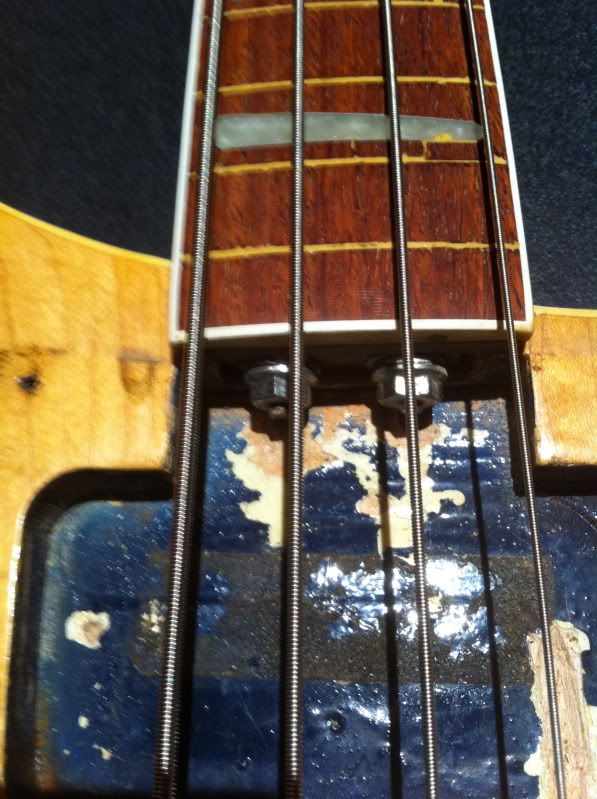
Also, the nuts at the headstock-end tend to bend down to the wood (it’s simply the nature of those rods to do that), and sometimes a bit hard to get the wrench onto them. From your photo it seems that the up-side-down old style rods might not have as much of that problem - maybe?
So, pros and cons with both top-end and bottom-end adjustment I believe.
Summa totalis, if it was me (with my limited experience) I would keep the original rods the way they are. But if it was me I probably would get a one-piece pickguard to make it look better

- not that simple to remove for truss rod adjustment of course, but don’t need adjustments that often anyway.