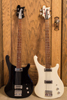
About a year ago, I bought a new 2004 660/12 which I absolutely love. It's a great guitar in every sense, and it has been a key element of my band's recording this weekend in the studio.
I also appreciate some of the vintage features (checkered binding, full-width fingerboard inlays, toaster pickups, etc.). I bought it based on comparisons with other available new 12-stringers. My apologies if this is an old topic, but I am learning more about Rickenbackers all the time from this forum, and I was wondering if someone could post a quick synopsis of the 660 model's history, evolution, etc. I really think it's one of the truly special and great guitars made today.
Ancestry of the 660 model
Moderators: rickenbrother, ajish4
The Rickenbacker 660/12 is really a continuation of a guitar that was designed as a Limited Edition. The 660/12 TP was introduced in 1991.
The 660/12 was based, no doubt, on Mike Campbell's 1963 625/12, which graces the cover of the "Damn The Torpedoes" album, released in 1979. That guitar, in and of itself, has an interesting history. Mike Campbell bought the 625/12 for $125 in 1974, completely unaware that it was the third Rickenbacker 12-string ever built, and the first solid-body. The serial number is CM 108, just one number away from George Harrison's 1963 360/12. It is reportedly one of only two 625/12's built in the '60s.
Back to the 660/12. When Rickenbacker and Petty were collaborating on Tom's signature model, they asked him what he would like on it. The number one feature was that he wanted a wider neck. So it was designed with a 1.75 inch width at the nut. I do not know if the other vintage features were decided upon by Tom or by Rickenbacker. In addition to the full-length triangle inlays, vintage tuners, tailpiece, knobs, guards, pickups, and truss rod cover, There is the decidedly non-vintage 12-saddle bridge, which continues on the 660/12, of course.
In any case, it was released to rave reviews in 1991, and the Limited Edition of 1000 was made through 1999. The LE was made only in Fireglo and Jetglo (mostly Fireglo; only 186 Jetglo were made).
When the Limited Edition ran out, Rickenbacker decided to keep making the guitar as the 660/12. They also introduced a 660 6-string, which was not part of the Tom Petty Limited Edition. All standard Rickenbacker colors are available. Have you ever seen a 660/12 Montezuma Brown? Beautiful!
I am sure that the availability of the 660/12 has held the line somewhat on the value of the 660/12TP; however, they do continue to appreciate, and are a valuable collectible RIC.
The neck profiles vary over the years. The TP had a slim neck profile, but the early 660 ("non-Pettys") had a fatter neck profile. They seem to have gone back to a slimmer profile in subsequent years. The Vintage pickups were revamped, along with all Rickenbacker Vintage pickups, in 1999, with a lower resistance figure (7.4K or so, as opposed to 11-13K) and vintage "scatterwinding", which replicates the old hand-guided winding machines of the '50s and '60s.
The charactered wood is also a great feature of the 660/12. Some of the TPs from the 1994-95 era have insane birdseye and these are my favorite.
Check out the Rickenbacker site for more info. They have a wealth of details on the 660/12TP, including the original press release, and final production totals.
You have a great guitar. Enjoy it and use it well.
The 660/12 was based, no doubt, on Mike Campbell's 1963 625/12, which graces the cover of the "Damn The Torpedoes" album, released in 1979. That guitar, in and of itself, has an interesting history. Mike Campbell bought the 625/12 for $125 in 1974, completely unaware that it was the third Rickenbacker 12-string ever built, and the first solid-body. The serial number is CM 108, just one number away from George Harrison's 1963 360/12. It is reportedly one of only two 625/12's built in the '60s.
Back to the 660/12. When Rickenbacker and Petty were collaborating on Tom's signature model, they asked him what he would like on it. The number one feature was that he wanted a wider neck. So it was designed with a 1.75 inch width at the nut. I do not know if the other vintage features were decided upon by Tom or by Rickenbacker. In addition to the full-length triangle inlays, vintage tuners, tailpiece, knobs, guards, pickups, and truss rod cover, There is the decidedly non-vintage 12-saddle bridge, which continues on the 660/12, of course.
In any case, it was released to rave reviews in 1991, and the Limited Edition of 1000 was made through 1999. The LE was made only in Fireglo and Jetglo (mostly Fireglo; only 186 Jetglo were made).
When the Limited Edition ran out, Rickenbacker decided to keep making the guitar as the 660/12. They also introduced a 660 6-string, which was not part of the Tom Petty Limited Edition. All standard Rickenbacker colors are available. Have you ever seen a 660/12 Montezuma Brown? Beautiful!
I am sure that the availability of the 660/12 has held the line somewhat on the value of the 660/12TP; however, they do continue to appreciate, and are a valuable collectible RIC.
The neck profiles vary over the years. The TP had a slim neck profile, but the early 660 ("non-Pettys") had a fatter neck profile. They seem to have gone back to a slimmer profile in subsequent years. The Vintage pickups were revamped, along with all Rickenbacker Vintage pickups, in 1999, with a lower resistance figure (7.4K or so, as opposed to 11-13K) and vintage "scatterwinding", which replicates the old hand-guided winding machines of the '50s and '60s.
The charactered wood is also a great feature of the 660/12. Some of the TPs from the 1994-95 era have insane birdseye and these are my favorite.
Check out the Rickenbacker site for more info. They have a wealth of details on the 660/12TP, including the original press release, and final production totals.
You have a great guitar. Enjoy it and use it well.


-
fading_fast
- New member
- Posts: 23
- Joined: Thu Dec 16, 2004 7:33 pm
One thing I'd like to know is the ratio of 6 string versions to 12 strings produced.
It seems to me that 660/12s are far more common than the 6 string. I saw my MG 660/6 hanging in the store and reserved it right away. That was late Dec 2004. I haven't seen another since.
It seems to me that 660/12s are far more common than the 6 string. I saw my MG 660/6 hanging in the store and reserved it right away. That was late Dec 2004. I haven't seen another since.
Master of the mighty G chord
-
beatcomber
- Member
- Posts: 222
- Joined: Sat Jan 24, 2004 6:00 am
"The neck profiles vary over the years. The TP had a slim neck profile, but the early 660 ("non-Pettys") had a fatter neck profile. They seem to have gone back to a slimmer profile in subsequent years."
Does this apply to the 6-string version as well?
I am seriously looking at placing an order for a 660/6, because I don't think that Rickenbacker (or anyone else) has ever made a more gorgeous instrument than a jetglo 660. One of the things I love most about Ricks is that narrow neck, and the supposedly wider neck of the 660 has been giving me second thoughts. Unfortunately, these guitars are just not available in stores to try before buying.
While on the subject, can anyone compare the tone of a 660 to a 300-series Rick with toasters? I've heard that they're similar, but with more of a Tele-like twang, which appeals to me.
Does this apply to the 6-string version as well?
I am seriously looking at placing an order for a 660/6, because I don't think that Rickenbacker (or anyone else) has ever made a more gorgeous instrument than a jetglo 660. One of the things I love most about Ricks is that narrow neck, and the supposedly wider neck of the 660 has been giving me second thoughts. Unfortunately, these guitars are just not available in stores to try before buying.
While on the subject, can anyone compare the tone of a 660 to a 300-series Rick with toasters? I've heard that they're similar, but with more of a Tele-like twang, which appeals to me.

That's right, Glenn, with the solid body and through-neck, it has a lot more sustain. Don't know about a Tele twang.
If you really love that narrow neck, be warned: you may not like adjusting to the wide neck. I prefer the smaller neck myself and sold a 660/12 shortly after buying it solely for that reason. I am much happier with my 330/12 and 360/12 necks. Perhaps consider a 620/12? Solid body, smaller neck. Of course, you miss out on the deluxe features, but life is a series of trade-offs, isn't it?
If you really love that narrow neck, be warned: you may not like adjusting to the wide neck. I prefer the smaller neck myself and sold a 660/12 shortly after buying it solely for that reason. I am much happier with my 330/12 and 360/12 necks. Perhaps consider a 620/12? Solid body, smaller neck. Of course, you miss out on the deluxe features, but life is a series of trade-offs, isn't it?
-
sloop_john_b

- Rick-a-holic
- Posts: 13843
- Joined: Tue Jan 25, 2005 6:00 am