Brian,I do believe you are referring to Jessica Beil (who is also quite the dish!)..Jessica Alba was the "Dark Angel"..
That Stealth movie cracked me up..Knowing a thing or two about "stealthy" flying machines,that plane in the movie would have a radar cross section the size of a small house!
"It's not the obscene thick gloss, but how it's applied"
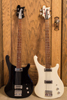
It is here. One thing I noticed right away is that the finish is different from the one we saw at the factory during the 75th celebration. That one, a bass, was done up in the DCM color but you could see the wood through the finish. This one has a definite metallic undercoat.
This paint finish is not entirely opaque, even with several coats being sprayed on over the sealed maple. The translucency of the paint, coupled with the natural variations in lightness/darkness of the maple, makes this sort of thing inevitable, and makes the guitars and basses painted in this color unique in more ways than one!
(I think of it as a sort of Burgundyglo with a bit of pearl added...)
“I say in speeches that a plausible mission of artists is to make people appreciate being alive at least a little bit. I am then asked if I know of any artists who pulled that off. I reply, 'The Beatles did.”
― Kurt Vonnegut
If it is not opaque it is damn close. There is no evidence of wood grain anywhere. On the DCM bass the wood grain could be seen under the ambient light of the factory floor.
I have a half-pint of the paint given to me by Eric for evaluation. Its opacity depends upon the thickness of the paint film, or the number of coats applied.
This is a common situation with metallics, pearls, and micas.
Here's why:
An ordinary solid color (say, Blue Boy) is formulated beginning with a white opaque pigmented base coat like titanium, tinted with small amounts of organic tints (in this case, Phthalo Blue and Perindo Maroon). Base coats are opaque, tints are translucent, for our purposes and in the paint system which I use. The organic tints are translucent, not opaque. Were you to spray a coat of BB onto a test panel, you would achieve full coverage in two coats.
(A test panel is a small--the ones I use are 4" X 6"--piece of aluminum with a baked-on primer coat, and, for opacity testing, a white base coat onto which a 1" black checkerboard is silk-screened in baked enamel. Opacity is measured by how many coats of paint it takes to render the checkerboard invisible.)
Other types of test panel merely have a baked-on primer and no checkerboard. These are used for other evaluation purposes.
The vast majority of metallic, micas, and pearlescent colors are formulated in an entirely different manner, not using a base color like white as the anchor for the formulation, but rather using a transparent base, usually clear mixed with a binder, balancer or basecoat converter, depending upon the manufacturer's chemistry.
Why clear? Simply put, to lend depth to the reflective pigments contained in these formulas. Sometimes these glamour-type colors are so translucent that they are practically transparent and require a separate, opaque ground coat to be sprayed first if the substrate (in this case, the sealed maple) must be prevented from being seen . A good example of this is the old "Ruby" color from the '80s and '90s. This is actually RIC's version of the old classic Candy Apple Red, painted over a silver ground coat (Fender uses a gold ground coat for their version). These, and many high-style pearlescents, are termed "multi-stage" paint finishes. They are, obviously, time-consuming to apply and to detail, and are often formulated for automated spray systems.
Usually, a metallic, mica, or pearlescent finish--which, remember, are formulated from clear bases with translucent organic tints for color--is made with enough reflective material (a ground aluminum or pearl powder, or mica flakes) that it can be applied without a ground coat. Most "ordinary" metallic finishes (popular since about 1950 or so, when Buick introduced their "Metallic-Chrome" finishes, although used as early as 1941 on Lincoln Continentals) can be applied this way.
Which brings us to the DCM situation. The 4003 at RIC75 was only the second instrument painted with this finish. I think it's safe to say that RIC's paint department was still getting their feet wet, so to speak, with this new color. DCM, unless it has been re-formulated since I got the sample, is more translucent than many metallics or one-stage pearls that I've encountered or formulated.
What you saw on the floor was more see-through than the production models I've seen since. So your eyes did not deceive you. I did pull the 4003 out of its case before writing this, and even in fairly low ambient light, there's no question that the walnut headstock wings are obvious.
Some people might see this as a defect (I wonder why? It isn't so with BG, and the two Ruby 360WBs I own, built eight years apart, are also about three shades different, due to amount of this translucent paint that was sprayed.), but I see it as just one more charming indicator that our instruments are built and finished by hand, by real human beings.
“I say in speeches that a plausible mission of artists is to make people appreciate being alive at least a little bit. I am then asked if I know of any artists who pulled that off. I reply, 'The Beatles did.”
― Kurt Vonnegut
John Hall and Eric have both alluded to a certain learning curve for new colors. If yours was the second application, they were as you say, getting their feet wet. In any event, the color is beautiful and well applied. I can't wait to get my 4003! I really like your handiwork too Paul.