Those scratches look like somebody used something abrasive to clean something else off and ended up scratching the heck out of the guard. The good news is that it's not a difficult fix and it can be done without tools. It just takes some work. Back when I was in college, I worked for a sculptor and part of my job was hand polishing sawn, beveled edges of big 3/4" thick plexiglass disks that were used for bases to set his sculptures on, so a little old pickguard is a walk in the park by comparison. I don't own a buffer, so I do the work by hand. You do need some specialized sandpaper to do it, but it's affordable and worth having. Essentially, what you are going to do it take the entire surface of your guard down to a level just below the deepest scratches, and then polish it back up until it looks shiny and new. It sounds like a lot more work than it really is and the actual amount removed in almost microscopic, but the end results are dramatic.
There are various methods, but this is how I polish the plexi on my guards with no power tools. You will need some "wet-or dry" sandpaper from a hardware or automotive store and you will be using it wet. This is a specific type of paper designed not to fall apart when wet. If you ask for wetsanding paper, they'll know what you need. One sheet of 320 grit and one sheet of 400 grit will most likely do. They usually run maybe 80 cents per sheet or so. As the numbers get bigger, the grit on the papers gets smaller (finer). The other "sand paper" I use isn't really paper at all, it's called "Micromesh" and I use an assortment of their cloth-backed 5" diameter disks. They're made to stick on power sanders, but I use them by hand for wet sanding. They aren't exactly cheap at about $18 per set, but they last for a long time and are one of the best sources for assortments of extremely fine grits. I get them from places like Woodcraft.
http://www.woodcraft.com/Catalog/Produc ... 6011fa7821
The 5" disk set will get you nine disks ranging from 1,500 grit all the way up through 12,000 grit.
You will also need a sink, a flat surface to work on (I usually use a cutting board on the kitchen counter) and a small block of wood (it's the highly sophisticated tool, you supply the power). To finish off, you'll need a rag and some Scratch-X or other polishing compound and some Zymol or other wax (if desired). Start by removing the guard and all of its electronics. Old guards can be a bit brittle, so you want to work with it flat on the cutting board to support it. Wet guards are also slippery, so don't drop it.
Start with the 320 grit paper, torn into 1/4 sheets and wrapped around the block of wood. Dunk it under the running water and start rubbing the surface with medium pressure. You can use circular or back-and-forth motions, it doesn't matter much. The water both lubricates the sanding action and helps keep the paper from plugging up with removed plastic. Re-dunk the block and paper as needed to keep it moving nicely.The block helps keep everything flat, so that you're not sanding dents or hollows into the surface. Do the entire top surface. 320 is usually enough to take out anything from playing wear. This grit takes care of about 95% of the removal stage for scratches. The following grits are mostly just slowly polishing the surface. Every once in a while, run the guard under the water, wipe it off and see how the scratches look. You want to continue until they are gone and the entire surface is covered with a uniform pattern of tiny scratches. For a bass guard, this step might take 20-30 minutes if it's deeply scratched. Coarser paper could be used (220 grit) for really deep ones, but it usually isn't needed.
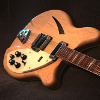
Here is one of the upper guards from my 370/12WB. For demonstration purposes, I took a map tack and made a big batch of fairly deep, nasty scratches in the middle. The second photo shows the wood block and a micromesh disk being used.(Damn, I'm getting big, old looking hands! It's no wonder I have to rebuild the nuts on all my twelves so that my fingers fit on the fingerboard). It probably took about 5 minutes with the 320 to get down below all those scratches and yield an even looking sanded surface on this one. A bass guard would take a bit longer, simply because it's bigger.
More to follow.







 good buffing wheel with sequence of compounds will polish it out, if it is wet sanded with 1200 & 1500 grit first it will go faster.